
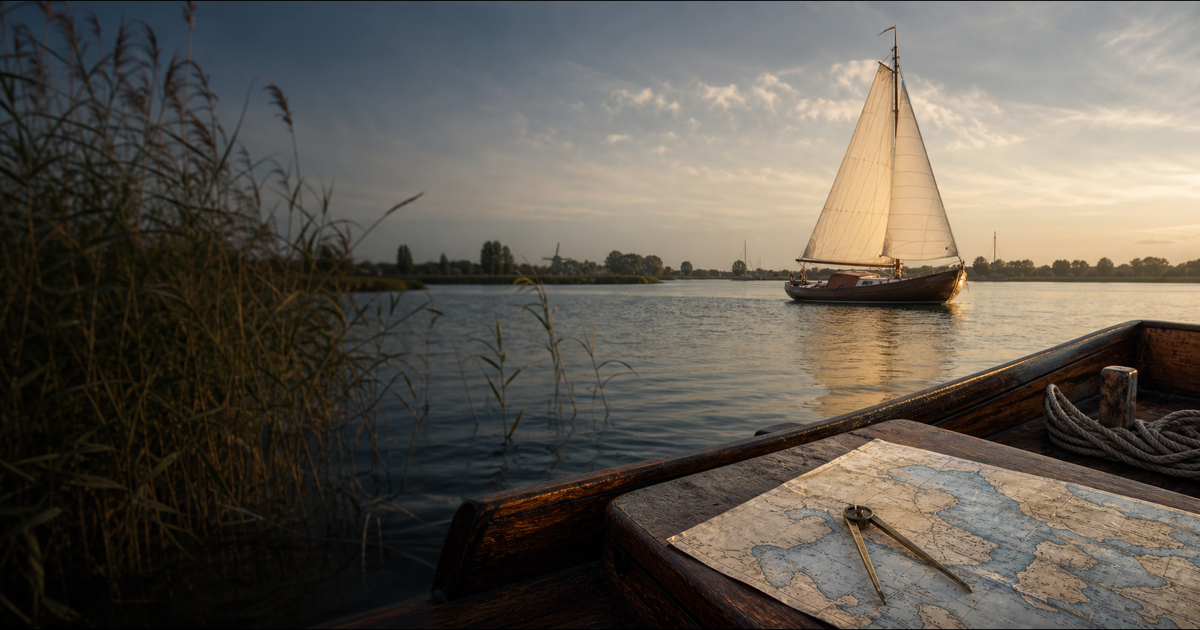
Since writing my honest guide to sailing in Friesland, the same question keeps coming back: fine, I am convinced, but where do I actually go? Open a map of Friesland and you see the problem. The province looks like someone spilled a glass of water over the Netherlands and never wiped it up. Dozens of lakes, hundreds of kilometers of canals, all of it connected, none of it labeled "start here."
So here is the missing piece: three routes I would actually sail, sized for a first day, a long weekend, and a full week. I spent four years as a commercial skipper on traditional ships here, and this is the water I still sail for fun. No secret spots withheld. Frisians do not really believe in secret spots anyway. There is enough water for everyone.
Before you cast off
A few ground rules that make every route below work better.
The boat. All three routes assume the classic Frisian setup: a rented valk (the open six-and-a-half meter sailboat everyone learns on) for the day route, and a small cabin yacht for the weekend and week. In the Netherlands you need no license for boats under 15 meters that cannot do more than 20 kilometers per hour, which covers all of it. Rules change, so check the current Dutch government requirements when you book.
The wind. Friesland's default wind is southwest, force 3 to 5. Plan your outbound legs into the wind and your homeward legs with it behind you. Beating upwind at the end of a long day with a tired crew is how nice holidays end in arguments.
The pace. This is the mistake everyone makes: planning distances like a car trip. On the lakes, 25 to 30 kilometers is a full, satisfying sailing day once you add bridges, locks, and the second coffee in a village harbor. Bridges have opening hours and lunch breaks. Build slack into every plan, then use the slack. The slack is the holiday.
Mooring. Three options everywhere: marinas with all facilities, village box berths in the heart of town, and Marrekrite spots, the free moorings on islands and shorelines maintained by the province. For the Marrekrite spots you buy a small yearly pennant that funds the system, and it is the best money you will spend all trip. Check the current mooring rules and bridge opening times shortly before you leave, because both change with the season. Falling asleep on your own island beats any marina.
Route 1: The first day. The Sneekermeer loop.
Base: Sneek or Terherne. Boat: a valk. Distance: relaxed.
If you have exactly one day and zero experience, this is the day.
Leave Sneek through the Houkesloot, the canal that runs straight from the city harbor to the Sneekermeer. The transition is the whole show: twenty minutes of canal, then the water opens up and you are on the most famous sailing lake in the Netherlands with the sails up and the engine off.
Sail the lake in a lazy clockwise loop. For lunch, moor at one of the Marrekrite islands on the eastern side, where the Sneekermeer spills into the Goingarijpster Poelen. Swim if it is warm. It will not be deep. Nothing here is. That is a feature: the worst thing that happens to a beginner on this lake is a soft, slightly embarrassing stop in the mud, followed by pushing off with the boat hook and pretending it was intentional.
In the afternoon, cross to Terherne on the northeast shore for coffee or an ice cream. Terherne is a village that practically floats, famous in the Netherlands for a children's book series about two boys and a boat, and it takes its role seriously. Then run home to Sneek with the wind behind you, drop the sails in the Houkesloot, and hand the boat back tired in the specific way only a day of wind and water produces.
If a skûtsje race is on the Sneekermeer that day, change all plans, anchor at the edge of the course, and watch. I explain what you are looking at in the Friesland guide.
Route 2: The long weekend. The southwest circuit.
Base: Heeg. Boat: small cabin yacht. Three days, two nights.
This is the route I recommend to couples and friends who can sail a little and want the full Friesland feeling without ambition.
Day one: Heeg to Woudsend. Start on the Heegermeer, and take your time. It is arguably the prettiest of the big lakes, wide and quiet with reed borders. Work south into the Fluessen, its bigger and emptier sister, and just sail: this is the best open water in the southwest corner. Late afternoon, thread into Woudsend, an old skipper village stuffed with history, a working windmill, and exactly the right number of terraces. Take a box berth in the village center and eat well.
Day two: Woudsend to Sloten via the Slotermeer. A short morning leg onto the Slotermeer, which means you have the whole afternoon for Sloten. Sloten is the smallest of Friesland's eleven cities, a fortified miniature with a moat, a windmill, and one main street that has not changed since cannons were a municipal concern. Tourists drive hours for it. You arrive by water like the town intended. Moor, walk it in forty minutes, then have the long unhurried dinner the place demands.
Day three: back north, the long way. Recross the Slotermeer early, when it is glass, and run the canals back toward Heeg with a lunch stop wherever a terrace looks correct. You will be back at the rental dock by late afternoon, already negotiating with yourself about doing a full week next year.
Route 3: The week. The grand circle.
Base: Sneek. Boat: cabin yacht. Six to seven days.
The full tour: lakes, canals, five or six villages, one national park, and an optional taste of big water. Clockwise, because of that southwest wind.
Day one: Sneek to Grou. Northeast via the Sneekermeer and the connecting canals to Grou, a proper sailing village on the Pikmeer. Good harbors, good food, and the spiritual home of skûtsjesilen. The season starts here every July.
Day two: the Alde Feanen detour. From Grou, day-trip east into the Alde Feanen, the national park: a maze of peat lakes, reed beds, and waterways full of birds. Take it slow, engine off wherever the width allows. This is the day you realize Friesland is not a sailing area with nature around it. It is nature with sailing threaded through it. Overnight in the park at a Marrekrite mooring if the weather is kind. It will be the quietest night of your year.
Day three: Grou to Langweer. South through Terherne and across the Sneekermeer's eastern poelen to Langweer, a small village with a big sailing reputation. Short leg, long evening.
Day four: Langweer to Sloten. Down through the Langweerder Wielen, past Woudsend, onto the Slotermeer. You know about Sloten from route two. It is even better midweek.
Day five: Sloten to Stavoren, the big-water option. West to Stavoren on the IJsselmeer coast, the oldest of the eleven cities, salt-worn and stubborn. If the forecast is gentle and the crew is willing, poke out through the lock onto the IJsselmeer for an hour to feel real fetch under the hull, then come back in. If the forecast is not gentle, respect it. The IJsselmeer is an inland sea with a short, steep chop that has humbled better sailors than any of us. The lakes will still love you.
Day six: Stavoren to Heeg. Back inland through the Johan Frisokanaal to the Heegermeer and the loveliest closing afternoon of sailing on the trip. Overnight in Heeg.
Day seven: Heeg to Sneek. A short, easy leg home, timed around bridge hours, with a last Marrekrite lunch stop. Hand the boat back, check house prices, feel things.
The evening ritual
Whichever route you sail, the days end the same way, and it is the actual point of Friesland: boat moored by five, shower, then a village terrace while the light goes long and gold over the water. The lakes are not dramatic sailing. The Wadden Sea, one province border north, covers dramatic. I did four years of it professionally. The lakes are something rarer: completely unhurried sailing in a landscape built for it over eight centuries.
When to come
May and June: quiet water, long days, everything open, my pick. July and August: livelier, busier harbors, and the skûtsje racing weeks, which are worth planning around even though they fill the villages. September: golden light, empty lakes, slightly moodier weather, the connoisseur's month. Book boats ahead for high summer, especially out of Sneek and Heeg, and bring layers in any month. This is still the north, and the weather keeps its own schedule.
If Friesland itself is the question (why here, what it costs, what a skûtsje even is), start with the full guide. And if you end up on the Sneekermeer some July afternoon watching fourteen century-old cargo ships race like their villages' honor depends on it, because it does, you will understand why I moved here and never left.
Fab
Frisian lakes routes FAQ
How many days do you need to sail the Frisian lakes?
One day is enough for a genuine taste (the Sneekermeer loop), a three-day weekend covers the prettiest southwest lakes, and six to seven days does the full circle of lakes, villages, and the Alde Feanen national park without ever rushing. Distances are short. 25 to 30 kilometers is a full sailing day here.
Can beginners sail these routes?
Yes, deliberately so. The water is shallow with a soft bottom, on the main lakes a harbor is rarely more than an hour or so away, and the standard rental valk is the most forgiving boat there is. No license is needed for boats under 15 meters that stay under 20 kilometers per hour. Start with the day loop, and save the IJsselmeer excursion for when you have some hours logged.
What is the best base for a sailing week in Friesland?
Sneek for the biggest choice of rental boats and the liveliest harbor, Heeg for quieter charm with direct access to the best lakes. Grou, Terherne, Woudsend, and Langweer all work too. You genuinely cannot choose wrong. The network connects everything.
Do I need to book moorings in advance?
Usually not. Village box berths and marinas mostly work first come, first served, and the free Marrekrite moorings (covered by a small yearly pennant) are everywhere. It still depends on route, season, and weather: in July and August arrive by late afternoon for the popular villages, and check current harbor information before you set off. Book the boat itself well ahead in high season.
When is the best time to sail in Friesland?
May, June, and September for quiet water and easy moorings. July and August for atmosphere and the skûtsjesilen racing weeks. The season runs May to September, the wind is reliable all of it, and none of it is warm enough to skip the layers.