Every July, something happens to Friesland. The lakes fill up with white sails, every village harbor smells of coffee and diesel, and for two weeks the entire province stops pretending to care about anything except a fleet of hundred-year-old cargo ships racing each other. If you have never seen it, you are missing one of the best sailing spectacles in Europe. And if you have never sailed here at all, you are missing one of the best sailing regions in Europe, full stop.
I can say that with a straight back. I spent four years as a commercial skipper on 40-meter traditional sailing ships, much of it on the Wadden Sea along Friesland's northern edge. Then I moved here and never left. I came to the Netherlands for the sailing. I know exactly what this place offers, and it still surprises me how few people outside the Netherlands have any idea it exists.
So here it is: my honest guide to sailing in Friesland. Where to go, what to sail, what it costs in effort and money, and why you should plan your visit around a boat race that most of the world has never heard of.
Why Friesland Beats the Famous Places
When people dream about sailing holidays, they picture Croatia, Greece, maybe the Balearics. Beautiful, sure. Also expensive, crowded, and unforgiving if you actually want to learn to sail rather than motor between beach bars.
Friesland is the opposite in almost every way that matters.
The province is basically a water network with some land in between. Dozens of lakes, all connected by canals, so you can sail for a week and moor in a different village every night without ever touching the same water twice. The water is shallow and the bottom is soft, which means the worst thing that happens to a beginner is a gentle, slightly embarrassing stop in the mud. The wind is reliable in a way Mediterranean sailors can only dream of. And the infrastructure is absurd: every village has a harbor, every harbor has showers and a bakery nearby, and the whole system is set up for people traveling by boat, because people have been traveling by boat here for centuries.
Then there is the rule that surprises everyone: in the Netherlands you do not need any license to helm a boat up to 15 meters, as long as it cannot go faster than 20 kilometers per hour. That covers practically every sailboat and rental sloop on the lakes. Check the current rules when you book, but the practical result is that a family with zero experience can rent a boat on a Tuesday morning and be sailing by Tuesday afternoon. Try that in Croatia.
The Two Worlds: Lakes and Wadden
Friesland offers two completely different kinds of sailing, and it helps to know which one you are signing up for.
The lakes are the friendly world. The Sneekermeer, the Pikmeer at Grou, the Heegermeer and the Fluessen, the Slotermeer, the Langweerder Wielen. Open water, no tides, no waves worth mentioning, a village harbor always within an hour. This is where you learn, where you take kids, where you spend lazy afternoons deciding which terrace to sail toward. If you capsize a dinghy here, someone will probably wave at you from a passing boat and ask if you want a beer.
The Wadden Sea is the serious world, and it was my office for four years. North of the Frisian coast, between the mainland and the islands of Vlieland, Terschelling, and Ameland, lies a UNESCO World Heritage tidal sea that is one of the most remarkable sailing areas anywhere. It empties and fills twice a day. Sandbanks appear and vanish. Navigation actually matters, tide tables actually matter, and getting it wrong means sitting on the mud for six hours thinking about your choices. Traditional flat-bottomed ships do this on purpose, by the way. Drying out on a sandbank at low tide, having dinner while seals watch from a hundred meters away, and floating off again at night is one of the great experiences of northern European sailing.
My advice is simple. Start on the lakes on your own. Experience the Wadden on a chartered traditional ship with a professional skipper, exactly the kind of job I used to do. You get the adventure without the responsibility, and the responsibility is real.
Where to Base Yourself
You cannot really choose wrong, but the villages have different personalities.
- Sneek is the capital of Frisian water sports. The biggest choice of rental companies, sailing schools, and nightlife. If you want everything in one place, start here.
- Heeg and Woudsend are the charming ones. Old skipper villages, beautiful harbors, direct access to the bigger lakes. My pick for a quieter week.
- Grou is where skûtsjesilen begins and a proper sailing village in its own right, on a lake that is pure pleasure in an open boat.
- Terherne and Langweer are small, family-friendly, and sit right on top of the best water. Terherne practically floats.
- Stavoren and Lemmer are the gateways. Both sit on the IJsselmeer, the huge inland sea, which is a good middle step between lake and Wadden sailing.
What to Sail
The classic Frisian rental boat is the valk, an open sailboat around six and a half meters, stable, forgiving, and quick enough to be fun. It is the boat generations of Dutch people learned on, and there is no better beginner boat anywhere. A day in one costs less than a mid-range hotel room, and most rental companies will give you a patient briefing before letting you loose.
If sails feel like too much commitment, rent a sloep, an open motor launch, and putter through the canals. No skill required, maximum terrace access. If you want to live aboard, cabin yachts are everywhere and turn the lake network into a floating road trip. And if you want the real Frisian experience, charter a traditional flat-bottomed ship, a tjalk or even a genuine skûtsje, with a skipper, and let someone else worry about the leeboards.
Skûtsjesilen: The Main Event
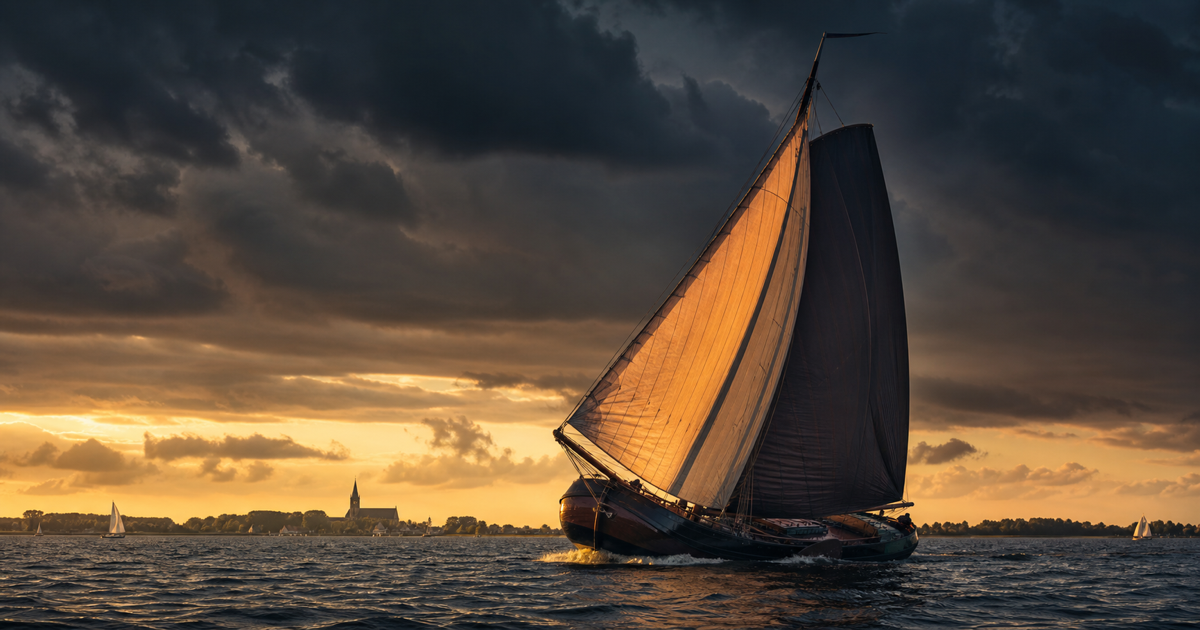
Now the spectacle. A skûtsje is a flat-bottomed cargo ship, around 20 meters long, built a century or more ago to haul peat and freight through these same canals. No keel, just massive wooden leeboards on the sides. When the cargo trade died, Frisians did the only sensible thing: they started racing the ships against each other.
The SKS championship is the premier league of this world. Fourteen skûtsjes, each representing a Frisian town or village, race a two-week tour across the province's lakes every summer. In 2026 it starts on Saturday, July 18 in Grou and ends on July 31 with the finale on the Sneekermeer, with races starting at 14:00 most days. In August, the IFKS follows with its own fleet and the same intensity. The skippers are local celebrities, several of them from families that have been racing the same ship for generations, and entire villages arrange their holidays around the results.
Watching it is free and unforgettable. These are heavy working ships with enormous sails, heeling until the water runs along the rail, crews hiking out over the side, crossing tacks with centimeters to spare. From the shore it looks dramatic. From a rental boat anchored along the edge of the course, surrounded by a few hundred other boats, a radio commentary drifting across the water, it is one of the best afternoons sport can offer. I have never raced one myself, and after watching a start from close up I have made my peace with that.
If you can time your visit to catch a race day, do it. Check the schedule on skutsjesilen.nl and pick a village, any village.
The Practical Bits
The season runs from May to September. June and September are quieter, July and August are livelier and busier on the water, and skûtsje weeks add a festival layer on top. Wind is rarely a problem here. Book boats ahead in high summer, especially in Sneek and Heeg, and bring layers even in August, because this is still the north and the weather has opinions.
One more local note. Friesland has a strong independent streak, and it shows up in unexpected places. Through Bitcoin Friesland, the local adoption project I run, I have gotten to know a growing group of business owners here who accept Bitcoin as payment. A province that spent centuries trading and sailing on its own terms turns out to be fertile ground for peer-to-peer money. It fits, if you think about it.
Why This Place Gets Under Your Skin
I grew up in Switzerland, a country of mountains and precision. I have sailed the North Sea in weather I would not wish on anyone. And yet the sailing that has stayed with me most is this: an evening on a Frisian lake, flat water turning gold, a village church tower on the horizon, and the quiet knowledge that there is a harbor, a shower, and a decent meal twenty minutes downwind.
Friesland does not shout about itself. That is very Frisian. But if you love sailing, or think you might, this unassuming corner of the Netherlands will teach you more and charge you less than any glamour destination. Come in July, watch fourteen ancient cargo ships fight for glory, rent a valk the next morning, and see if you do not start checking house prices by the end of the week.
I did. Look how that ended.
Fab