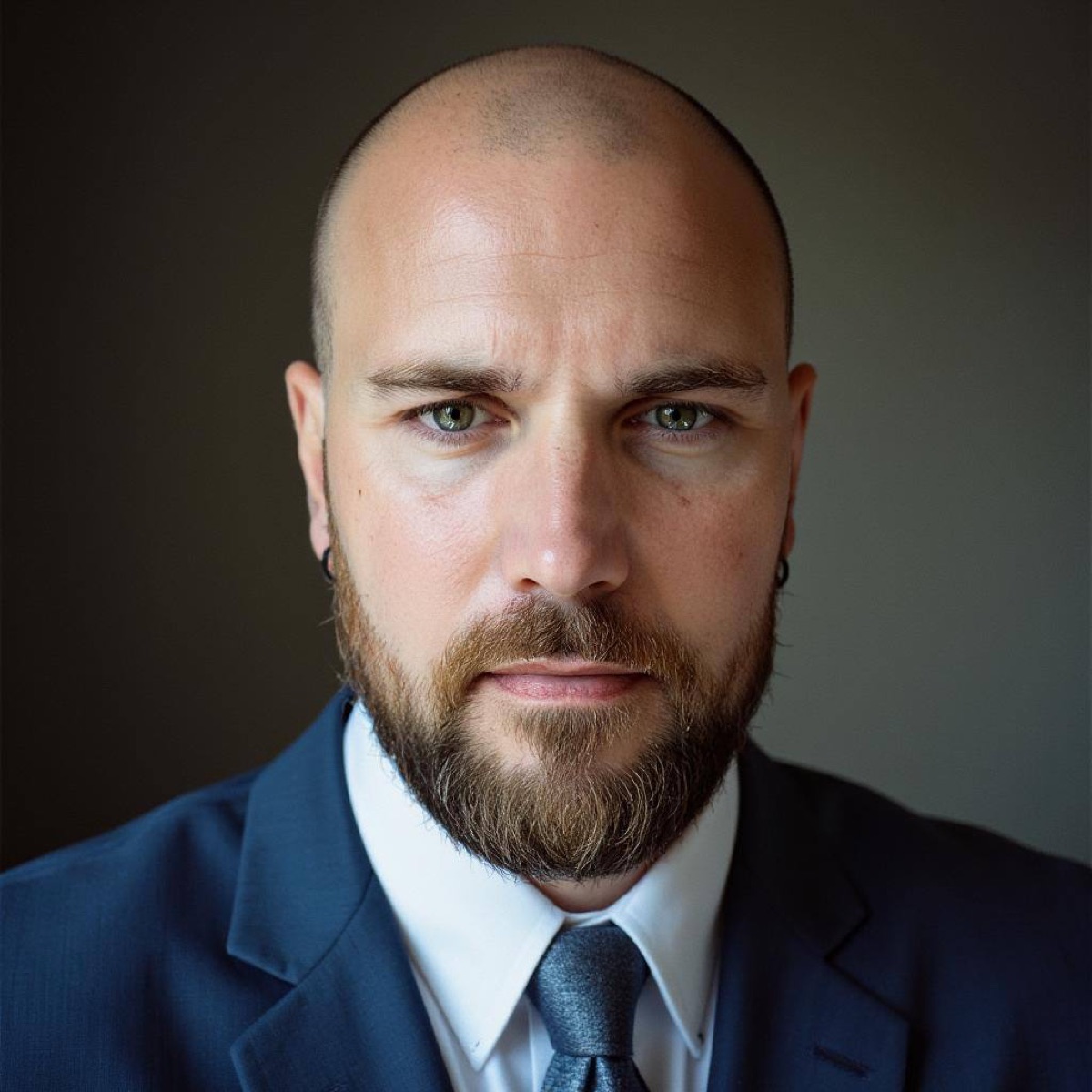
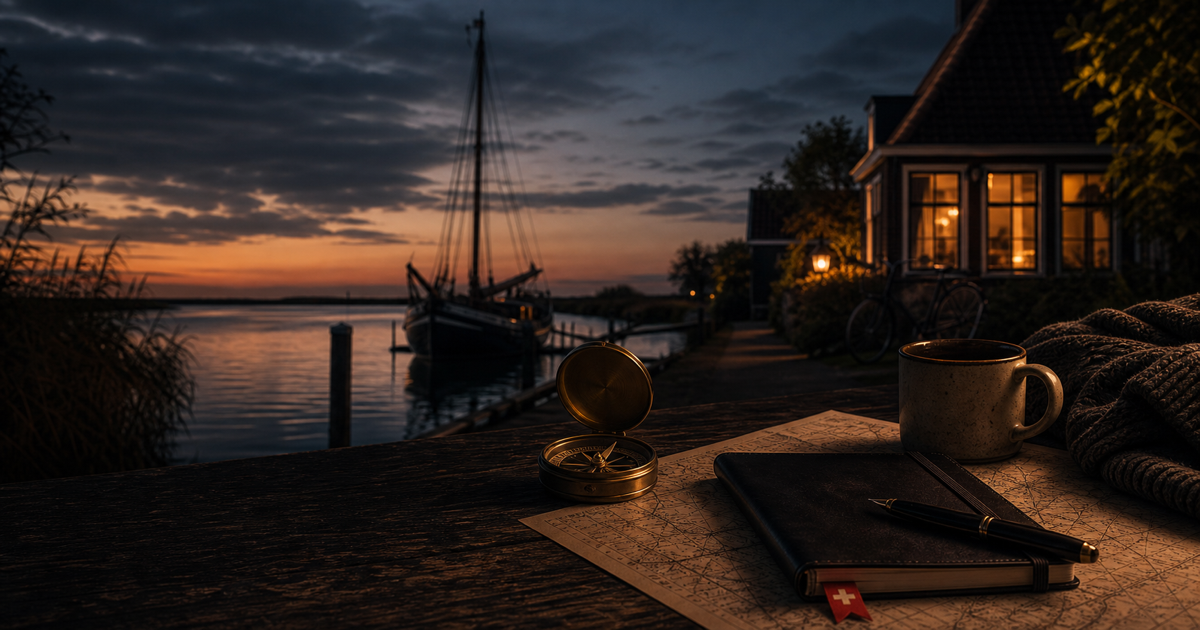
Every few weeks someone finds out I'm Swiss and living in Friesland, and they ask the same question with the same puzzled face: "Wait, you left *Switzerland* for *here*?"
I get it. Switzerland is the postcard. Mountains, chocolate, the strongest currency in Europe, some of the highest salaries on the planet. Friesland is flat, windy, and most people outside the Netherlands have never heard of it. They even speak a language here that isn't quite Dutch.
But the question has the story backwards. I didn't leave Switzerland for Friesland. I came to the Netherlands in 2016 for exactly one reason: to learn how to sail. Everything else, the wife, the kids, the dog, the house in Goutum, happened because I stayed. And I stayed for love.
This is the honest version of how a guy from a village of about 1,100 people in Kanton Aargau ended up a Frisian by choice.
I Came for the Sea
In my twenties I did something most people around me thought was a little insane. I walked away from the comfortable Swiss track to train as a sailor. Not weekend yacht sailing. Traditional ships, real responsibility, the kind of thing you can only learn by doing it badly until you slowly do it well.
So in 2016 I packed up and moved to the Netherlands, a country that has been arguing with the sea and winning for four centuries. I trained, I crewed, and for about four years I worked on traditional sailing ships, hosting guests, handling safety, learning the water in every kind of weather.
Four years at sea teaches you things no classroom can. You learn to make decisions with incomplete information. You learn that panic is a luxury you cannot afford. You learn that the weather does not care about your plans, your ego, or your schedule. To this day I run my businesses the way I learned to run a deck: plan carefully, prepare for the worst, then act without flinching.
I thought sailing was the whole story. It turned out to be the prologue.
Then I Met Nikki
In 2020, in Leeuwarden, I met Nikki.
The practical version: she's Frisian, she works in mental health care, and she is calm in exactly the places where I am chaotic. The real version is simpler. She is the reason I stopped moving. After years of treating the Netherlands as a place I was passing through, I suddenly had a reason to drop anchor for good.
People love to romanticize big life moves as bold solo decisions. Mine wasn't. The most important "relocation" of my life was not a plan on a spreadsheet. It was falling for someone and deciding that wherever she was, that was home.
We registered our partnership in January 2023. By then a much bigger change was already on the way.
Then I Became a Father
Noah arrived in March 2023. Ellie followed in November 2024. (We put "remember, remember the 5th of November" on her birth card, because how could we not.)
Nothing rearranges your priorities like watching your kids sleep at 3am, even when one of them, hi Ellie, refuses to actually do much of it. Becoming a father in Friesland, far from where I grew up, forced me to think hard about what kind of life I actually wanted to give them.
I'll be honest about why this cuts so deep for me. My own father died at 38, when I was nine. I built a whole image of him as a perfect, self-made man, partly because I never got old enough to see his flaws. Now I'm not far off the age he was when he died, raising my own son and daughter. That does something to you. It turns "be present" from a nice phrase into something I refuse to negotiate on.
So when I think about Friesland, I'm not really thinking about cost of living or square meters. I'm asking a simpler question: is this a good place to be a dad? Every single day, the answer is yes.
What Friesland Actually Gives Us
Let me be specific, because vague talk about "lifestyle" is useless.
Space and sky. We bought a house in Goutum at the start of 2026, with a garden, for a fraction of what a cramped apartment costs near a Swiss city. Friesland has enormous, dramatic skies, the kind you usually only see over open water, because the land is so flat that nothing interrupts the view. Our dog Floki, a black and white Friese Stabij, makes sure I'm out under that sky twice a day whether I feel like it or not.
A slower, realer pace. The kids will walk to school. Noah has extremely strong opinions about dinosaurs. We know our neighbors. Frisians are reserved at first and loyal forever, and once you're actually let in, you're properly in. That kind of slow, earned connection is worth more than a hundred shallow ones.
Values I already had. Friesland is practical, frugal, and allergic to flashiness, which lines up almost perfectly with how I think about money and Bitcoin. It's why I started Bitcoin Friesland, getting local businesses to accept Bitcoin and proving that sound, peer-to-peer money works in a farming province, not just in a tech hub.
The Expat Stuff Nobody Warns You About
If you're a Swiss expat, or any expat, actually thinking about moving to the Netherlands, here's the unglamorous practical stuff I wish someone had handed me.
Get your BSN first. Your first stop is the *gemeente* to register and get a BSN, the citizen service number. Almost nothing works without it: no bank account, no employment, no health insurance. Book the appointment as early as you possibly can.
Health insurance is mandatory and you pick it yourself. You have to arrange a private *zorgverzekering* within four months of registering. Do not sleep on this. The penalties for going uninsured are real.
Banking takes patience. Some Dutch banks still make life awkward for new arrivals. Bring your BSN, proof of address, and ID, and expect more paperwork than the country's efficient reputation suggests.
Learn Dutch even though everyone speaks English. The Dutch speak better English than almost anyone in Europe, which is a trap. It lets you coast for years without ever really belonging. Learn the language anyway. It's the difference between living *in* a place and living *next to* it. You don't need Frisian, but locals light up when you try a few words.
Prepare for wind, not cold. It's not really cold here. It's windy. A proper windproof jacket and a good bike will do more for your daily happiness than any heavy winter coat.
None of this is hard. It's just unglamorous, and nobody puts it in the brochure.
What All of This Taught Me
Here's the thing I keep coming back to.
I didn't engineer this life. I came for the sailing, fell for Nikki, became a father, and slowly built something I could never have drawn on a whiteboard at 25. But underneath the luck, one habit made the difference: I kept asking myself what I was actually optimizing for.
For years I'd been chasing the metrics the world handed me. Higher salary, more status, the responsible path. Those numbers quietly pointed me toward a life that looked successful and felt slightly wrong, like a shoe half a size too small. The good decisions in my life, leaving Switzerland to sail, staying for Nikki, settling in Friesland, all came from ignoring the default scoreboard and getting honest about what actually mattered to me.
That process of mapping your own variables before you make a big bet is the most valuable thing I do now. It's the entire reason I built The Clarity Map, a personalized life and career map drawing on Ikigai, behavioral psychology, and plain market reality, to help people see their own picture clearly before they gamble years of their life on a direction. Because the worst outcome isn't a bold move. It's a bold move toward the wrong thing.
If You're Sitting With That Itch
A few things I'd tell anyone standing where I once stood.
"Everyone thinks it's crazy" is not data. It's social pressure wearing a costume. The real question is whether a move serves what you're optimizing for, and you can't answer that until you've defined what that is.
Run toward something, not away. I didn't leave Switzerland because I hated it. I love Switzerland. I left because the sea, and then a person, and then a family, pulled me somewhere that fit better. Moves made purely to escape tend to pack the problem in the suitcase.
Give it longer than feels comfortable. The first year anywhere is mostly logistics and loneliness. The good stuff, the community, the rhythm, the feeling of home, shows up in years two and three. Don't judge the whole decision by its hardest chapter.
I came to the Netherlands to learn to sail. I stayed for love, then for a family, then for a flat, windy, ridiculously beautiful province that quietly became home. If you're sitting with that "something needs to change" feeling right now, don't ignore it. Get honest about what you actually want. Then move like you mean it.
Steen voor steen. Dag voor dag. Stone by stone, day by day.
Fab