
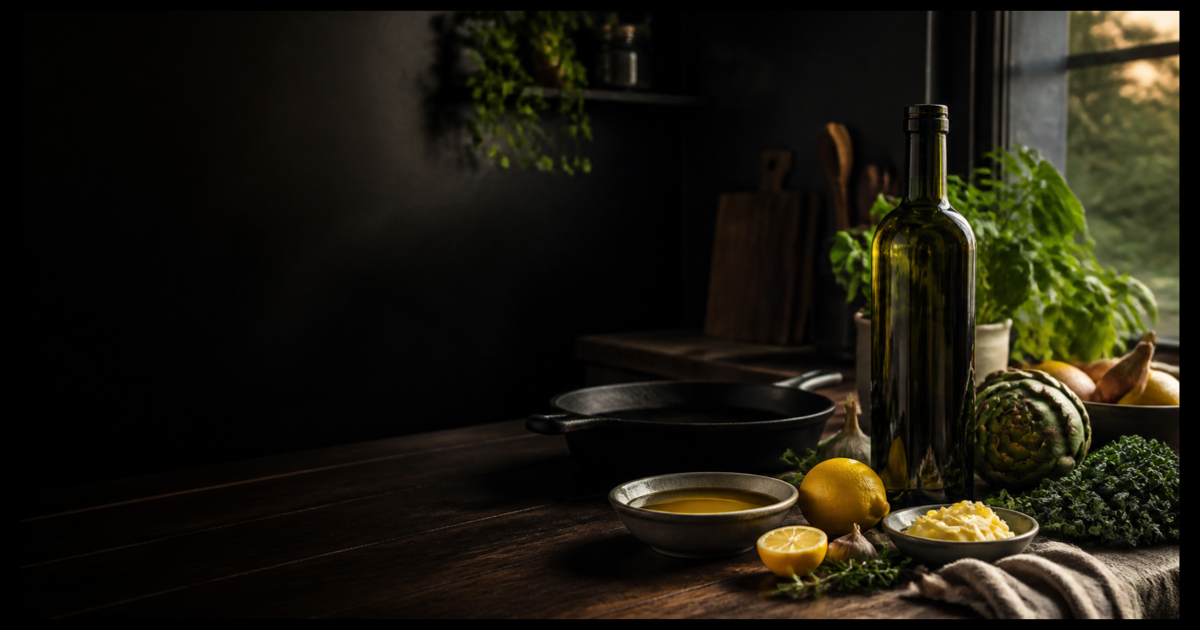
A guy at a barbecue this summer watched me pour olive oil on my salad and nodded like I had passed a test. "Good," he said. "Seed oils are killing everyone. Number one cause of every disease now." He said it with the calm certainty of a man who had watched exactly one podcast.
Here is the awkward part. I agree with his kitchen and completely disagree with his reasoning. I do not cook with seed oils either. My kitchen runs on butter, olive oil, and beef tallow. So you would expect me to clink glasses and agree that canola is quietly poisoning the Western world.
I cannot, because I actually went and read the research. And the honest answer is more boring, and a lot more useful, than either side wants to tell you. The people selling seed oils as the single villain behind modern disease are overselling a story the evidence does not support. The people telling you they are perfectly fine are missing why cutting them still quietly upgrades your diet. Here is the version that is actually true.
What a "seed oil" even is
We are talking about the industrial vegetable oils: soybean, canola (rapeseed), corn, sunflower, safflower, cottonseed, grapeseed. They are pressed and chemically extracted at enormous scale, then refined, bleached, and deodorised into a cheap, neutral, shelf-stable liquid. They barely existed in the human diet before about 1900. Today they are the default fat in nearly every processed food on the shelf and nearly every restaurant fryer in the country.
The case against them goes like this: they are very high in an omega-6 fat called linoleic acid, humans now eat far more omega-6 than our ancestors did, and that imbalance supposedly drives the chronic inflammation behind heart disease, diabetes, and the rest. It is a clean, satisfying story. It is also, on the strongest evidence we have, mostly wrong.
The scary claim does not survive the research
The headline accusation is that linoleic acid drives chronic inflammation in your body. The best human evidence does not support such a simple story.
A systematic review and meta-analysis of randomised trials found no significant overall increase in the usual blood inflammatory markers when linoleic acid intake went up. A large pooled analysis of 20 cohorts linked higher linoleic-acid biomarkers with lower type 2 diabetes incidence, while a separate review of prospective cohorts found lower coronary-heart-disease risk at higher dietary intake. None of that makes any oil a magic health food, and observational research cannot prove cause. It does make "seed oils are poison" a very poor conclusion.
That does not settle every question about cooking oils. It does mean the one-villain story is not supported by the human evidence we have.
I will be straight with you, because that is the whole point of this blog: it would be more convenient for me if the scary version were true. I already cut seed oils. When I wrote about my carnivore reset, I told you I had stripped them out, and I stand by that. I just want to be more precise about why than the internet let me be. I would rather be right than consistent.
So why do I still avoid them?
Three reasons. Not one of them is "linoleic acid is poison."
- They are the fingerprint of ultra-processed food. Where seed oils go, refined flour, sugar, additives, and 600 calories you did not taste tend to follow. The oil is not really the problem, the company it keeps is. Because seed oils are in almost all of it, "avoid seed oils" turns out to be a lazy but effective proxy for "avoid junk." In a controlled NIH trial, people eating a more ultra-processed diet ate more and gained weight, even when the meals were designed to be similar on paper. That does not prove seed oils were the cause. It does support caring about the whole food pattern.
- Beaten-up frying oil is a real concern. This is the one legitimate piece of chemistry. Oil that is heated hard, reused for days in a commercial fryer, and oxidised produces aldehydes and breakdown compounds you genuinely do not want. A fresh splash of sunflower oil on a salad has almost nothing to do with the sludge in a fast-food fryer on day four. Fry rarely, never in oil that has been cooked to death, and most of this worry evaporates.
- I just prefer fats that taste like something. Butter, ghee, tallow, olive oil. They are stable under heat, they make food taste better, and since I run StudioFab from home I cook most of my own meals anyway. That is a preference. I am allowed to have one without dressing it up as a molecular emergency.
What the honest science actually tells you to do
Here is the quietly useful part the outrage skips over.
The thing that matters more than fearing omega-6 is whether your diet has enough real food and enough variety. I eat oily fish regularly, and if you are considering a supplement, it is worth checking what actually fits your situation rather than treating an internet "ratio" as a diagnosis. Extra-virgin olive oil is a straightforward choice I enjoy and has a far better evidence base than online oil panic. And the real enemy is not a molecule. It is a category: ultra-processed food. The single most powerful move you can make is to cook actual food yourself. Do that, and the seed oil question mostly answers itself, because you stop eating the products they hide in.
How I actually run it, in real life
None of this is complicated or expensive. It is a pantry swap and a bit of frequency discipline.
- At home: butter, ghee, or beef tallow for anything hot, extra-virgin olive oil for anything cold or gentle. That covers every meal I cook. Total cost of switching: one afternoon and slightly different bottles.
- In the supermarket: I flip the bottle over. If sunflower, soybean, or canola oil sits in the first three ingredients of something that is not oil, a mayo, a dressing, a "healthy" cracker, I usually just put it back. Not out of fear. As a filter. It is a two-second signal that I am holding something ultra-processed.
- Restaurants and takeaway: I do not interrogate the waiter about the fryer. I eat the meal and enjoy it. I just do not eat deep-fried takeaway three nights a week, which was never a good idea for any reason. Frequency is the entire game.
- What I refuse to do: panic, pay triple for products stamped "seed-oil free," or believe one restaurant dinner undid anything. The guy sending his food back over canola is doing nothing for his health and real damage to his dinner invitations.
The actual lesson here is not about oil
If you take one thing from this, make it this, because it is worth more than any pantry tip.
The seed oil panic is a near-perfect specimen of modern health advice. Take a real, boring kernel of truth (ultra-processed food is bad for you, industrial frying oil oxidises), wrap it in a false, viral, absolute claim (this one molecule is silently poisoning you), and sell it through people who conveniently have a product, a supplement, or a subscription waiting on the other end.
So here is the filter I now run every health claim through. When something is simple, absolute, blames a single villain, comes with a thing to buy, and makes you feel like you have discovered a secret the sheep all missed, be suspicious. Reality is almost always more boring than that, and almost always about the whole pattern rather than one ingredient you can point at.
The boring truth: eat mostly whole food, cook it yourself, get your omega-3, do not deep-fry your life, and stop handing one bottle in your pantry the power to save or ruin you. If you want the full picture of how I actually eat, sleep, and train, it is in what my health routine really looks like and on my health and wellbeing page.
I cut seed oils, and I would tell you to cut the ultra-processed food they live in, eat more fish, and cook at home. I would not tell you they are poison, because as far as the evidence goes, they are not. Anyone selling you a single villain is selling you something. Usually, if you look closely, something literal.
The problem was never really the oil. It was everything it came wrapped in.
Fab