
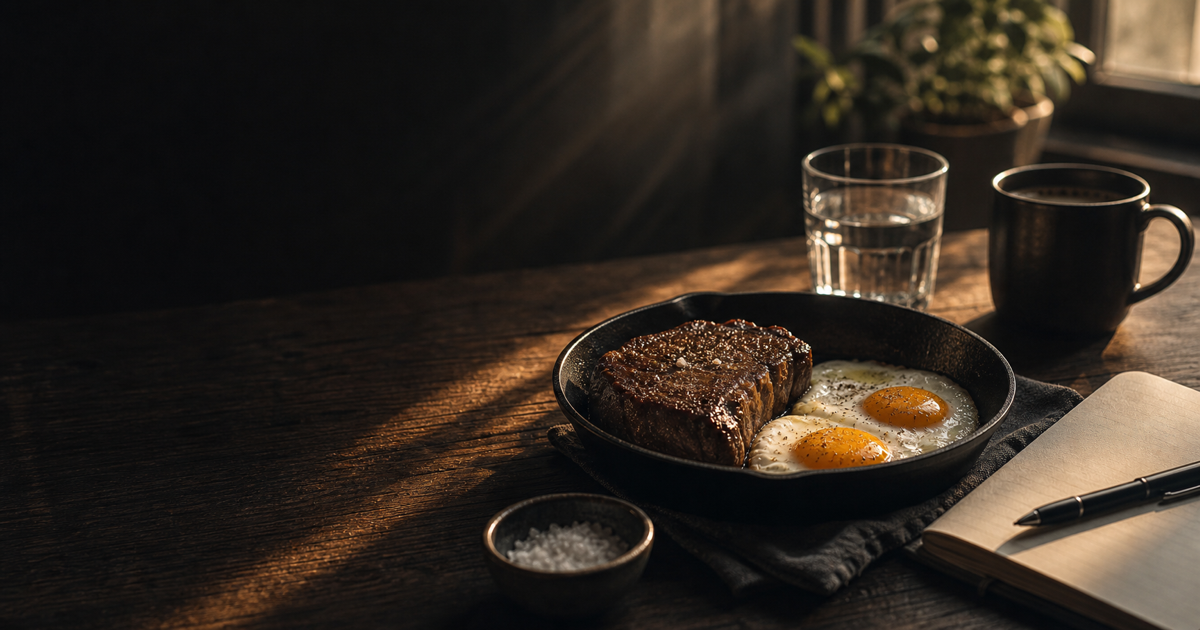
I probably never felt as good in my life as I felt on carnivore. Steady energy from morning to night. Clear head. Deep sleep. A calm, focused mood that made me better at work and better at home. Food stopped being complicated and just became fuel.
That was 2025. Three and a half months of eating nothing but meat, eggs, butter, and salt. I lost a lot of weight, my bloodwork improved across the board, and I genuinely wondered why I hadn't done this years earlier.
Then I stopped. Went back to eating whatever, drinking whenever. Nine months later I was back to where I started.
So I'm doing it again. But this time with a plan for what happens *after*, because that's where I failed, and it's probably where most people fail too. This post is the full picture: why carnivore works, how I run it, what I got wrong, and what I'd tell anyone thinking about trying it.
What Carnivore Actually Is
Think of it like a financial audit for your body. You strip everything down to first principles, just animal foods, and you give your system a chance to reset. Inflammation drops. Energy stabilizes. Mental clarity sharpens. Weight comes off.
It's not meant to be permanent. It's meant to be intense, focused, and temporary. Two to three months, once or twice a year. The rest of the year is where the real lifestyle work happens.
The idea isn't "meat forever." The idea is: remove everything, see how good you can feel, then carefully add things back while keeping the benefits.
What Happens When You Do It
If you've never tried it, here's what to actually expect.
Week 1. Headaches that disappear with salt. Possible nausea if your meals are too lean. Increased thirst. A metallic taste that confirms you're in ketosis. By the end of the week, mental clarity starts showing up.
Week 2. Sleep stabilizes and quality improves dramatically. Energy becomes steady, with no afternoon crashes. Appetite self-regulates. Taste buds sharpen. Meat tastes sweeter, eggs taste richer. If you've done keto before, adaptation is mostly complete.
Weeks 3 and 4. Visible fat loss, face changes first. Plateaus happen. Ignore them. Joint stiffness and puffiness fade. Sleep needs drop slightly but quality is higher.
Week 5 and beyond. Autopilot. Food becomes fuel. The relationship with food fundamentally changes. Energy and clarity become the new normal.
That progression is remarkably consistent. It's what keeps pulling me back.
Why It Works
You don't need to understand the biology to benefit from carnivore, but it helps to know why you're feeling different.
Your body unlocks stored energy. Insulin is the hormone that decides whether you're storing fat or burning it. A typical Western meal spikes insulin high. A day of meat and eggs barely moves it. Low insulin means your body can finally access its own fuel reserves.
Inflammation quiets down. When you simultaneously remove sugar, seed oils, processed food, alcohol, and grain, your body's background inflammation drops fast. The morning stiffness, the puffiness, the brain fog. You do not realize how much of that is dietary until it goes away.
Your brain runs on cleaner fuel. On carnivore, the brain switches from glucose to mostly ketones. Less metabolic waste, sharper thinking. The mental clarity isn't placebo.
Cellular cleanup kicks in. Autophagy, your body's maintenance crew, ramps up in ketosis. Damaged cells get broken down and recycled. It's the biological process behind "fasting feels like it heals you." Yoshinori Ohsumi won the Nobel Prize for discovering how it works.
On top of all that: growth hormone rises to preserve muscle, testosterone production gets better raw materials, and most men report more energy and drive by week three or four. I had that effect last time. Made me a better entrepreneur, and a slightly more intense husband for a few weeks, which Nikki tolerated with grace.
My Daily Protocol
I'm 36, 195 centimeters tall, and I started this round at 120 kilos. I've done keto seven times, carnivore once before, and roughly ten ten-day water fasts over the years. I've been doing intermittent fasting for about fifteen years. The body knows the drill.
Morning. Black coffee. A glass of water with half a teaspoon of Baja Gold salt. That's breakfast.
Fast until 13:00. I work from home running StudioFab, so the morning is for deep work. No food means no insulin response, no digestive load, no mid-morning crash.
Meal 1 at 13:00. 350 to 400 grams of gehakt (ground beef) cooked in its own fat, with four or five eggs scrambled in butter or ghee. Never drain the fat. The fat is the fuel.
Meal 2 at 17:30. Something richer. Ribeye, duck breast with the skin on, bavette, or short ribs from the slow cooker. 400 to 500 grams of meat, five or six more eggs, more butter, more salt.
Done eating by 18:00. Bedtime around 22:00, giving me a clean 19-hour fasting window.
I cycle between one-meal days and two-meal days. Keeps things flexible.
The cooking rule is simple: ghee, butter, or beef tallow. Never seed oils. Save rendered duck fat for the next day's eggs. Salt everything generously. On low insulin, your kidneys flush sodium constantly.
The Salt Situation
This is the thing most people underestimate, and it's what makes most of them quit in week one.
When insulin drops, your kidneys start dumping sodium. If you don't replace it, you get the classic "keto flu": headaches, fatigue, weakness. The diet is working fine. You're just running low on salt.
I aim for 5,000 to 7,000 milligrams of sodium per day. That sounds extreme. It is. Most people are at 2,000 to 3,000 and wondering why they feel terrible. The morning salt water is non-negotiable. If it tastes sweet instead of salty, your body is screaming that it's depleted.
One important warning on electrolyte supplements: most pills are dosed for athletes, not for someone on carnivore. And be especially careful with potassium. Meat is already rich in it. Stacking potassium pills on top of a meat-heavy diet can quietly push your levels too high. That happened to me last time, and it took months to figure out what went wrong. More on that in a moment.
What I Got Wrong Last Time
Two mistakes. Both avoidable.
First: I took electrolyte pills every day for months because the internet told me to, without checking my bloodwork. By the end of my carnivore block, my potassium was at the top of the normal range. I was overdosing without knowing it. Meat gives you plenty of potassium on its own. The extra pills were unnecessary and caused me problems I didn't connect until much later. Simple lesson: don't blindly supplement. Get bloodwork. Read labels. More isn't always better.
Second: I had no exit plan. Ended the diet and went straight to fries and beer. The weight came back, the habits slipped, and I was back to square one within nine months.
Both mistakes shaped everything about how I'm running this round differently.
What I Supplement Now
Magnesium in multi-form (citrate, taurate, bisglycinate, malate). 200 milligrams before bed. A meat-only diet is genuinely low in magnesium, and it helps sleep and prevents cramps.
Vitamin D3. 2,000 to 4,000 IU daily. Friesland is at the same latitude as Edmonton. The sun is a rumor up here for six months.
Omega-3 fish oil. 2 to 3 grams daily. Dutch supermarket beef is mostly grain-finished, which skews inflammatory. Fish oil rebalances that.
Salt. Enough to make a Dutch cardiologist nervous.
That's it. No potassium pills. No exotic stacks. The food does the work.
The Exit Strategy
This is the part that matters more than the diet itself, and it's where I had zero plan last time.
Week 1 post-carnivore. Whole foods only, no alcohol. Berries, avocado, sweet potato added alongside meat. Stay in low-insulin territory and let the body re-orient gradually.
Week 2. Rice, root vegetables, more variety. Still no alcohol.
Week 3. Broader reintroduction. Still no alcohol.
Week 4. Alcohol slowly, mindfully, two-drink maximum.
The transition is at least as important as the protocol. Don't celebrate the end of carnivore by ordering a pizza and three beers.
The Bigger Picture: Seed Oils
If you take one thing from this post and apply it permanently, take this one.
Industrial seed oils, meaning soybean, canola, corn, sunflower, safflower, cottonseed, and grapeseed, did not exist in the human food supply before the early 1900s. They're extracted with petroleum solvents, bleached, and deodorized. The result is extremely cheap, extremely shelf-stable, and extremely high in omega-6 linoleic acid.
Humans evolved on an omega-6 to omega-3 ratio of roughly 1:1 to 3:1. The modern Western ratio is 15:1 to 25:1. That imbalance drives chronic inflammation at a cellular level and takes one to two years to clear from your body fat.
Each carnivore block helps purge stored seed oils. But the real fix is never adding them back. Restaurant fries, packaged snacks, salad dressings, mayonnaise. Seed oils are in almost everything. Swap them for olive oil, butter, ghee, beef tallow, coconut oil, or avocado oil. That's it.
This is the single most impactful permanent dietary change anyone reading this can make.
The Historical Perspective
You can think about carnivore from physiology, which is what I've been doing, or from history.
The Inuit, on a 90 to 95% animal diet, had near-zero heart disease, diabetes, and obesity until Western food arrived. The Maasai, eating cattle blood, raw milk, and meat, had some of the lowest cholesterol and heart disease rates ever recorded. The Mongolian steppe nomads built the largest land empire in human history on dried meat, blood, and mare's milk. The Samburu of northern Kenya ate 400 grams of animal fat per day with virtually no heart disease.
Every population that ate predominantly animal foods showed low rates of metabolic disease. Every population that transitioned to Western diets showed catastrophic health decline within a single generation.
I'm not arguing we should all eat like the Inuit. I'm arguing the human species has thrived on meat-heavy diets for longer than recorded history, and the burden of proof is on the people calling that suddenly dangerous.
Alcohol on Carnivore
Honest take: alcohol on ketosis hits harder. Two drinks feel like four or five.
If you drink, gin or vodka with sparkling water and lime is your friend. Zero carbs, zero sugar. Beer destroys ketosis. Wine isn't terrible. Cocktails with syrups are a no.
But the bigger truth: alcohol stops fat burning while your liver processes it, disrupts deep sleep by 20 to 40% even at two drinks, and the next day your cravings return and your energy tanks.
My rule for this block: two or three planned social events over the entire protocol. Planned drinks are manageable. Unplanned "I just had a couple" nights are how the whole thing unravels.
Being Honest About the Pattern
My pattern so far has been: lose 15 to 20 kilos during a carnivore block, drift back to normal eating, gain most of it back over nine to ten months. Run another block. That's weight cycling, and some research suggests it's worse than just staying at a higher weight.
The problem isn't carnivore. Carnivore works. The problem is what happens between protocols. I've been treating carnivore as a rescue mission instead of a tune-up.
What I'm committing to this time: an animal-based whole food baseline year-round. 60 to 70% of calories from animal sources. Carbs as a condiment, not a staple: berries, seasonal fruit, sweet potato, white rice when training hard. Permanently eliminated: seed oils, refined sugar, wheat flour, ultra-processed anything. 80/20 rule: clean most of the time, eat freely on social occasions that matter. Weight guardrail at 110 kilos. If the scale crosses that line, I tighten up the same week.
If I run this for a year and don't need another rescue block in 2027, that's the real win.
Where I Am Now
First 12 days of this round.
Weight: 120 to 113.8 kilos. Mostly water and inflammation dropping early on. Real fat loss kicks in around week three.
Sleep: Garmin score went from volatile to consistently High. Sleep is the single best indicator that the protocol is working.
Steps: hitting the 12,000 daily target. Last year's average was 9,220.
Target by June 22: 106 to 108 kilos. Target by end of August after a second block: 100 kilos.
Why I'm Writing This
Not to convince anyone to go carnivore. Not to sell a protocol or a supplement.
I'm writing this because the first time I did it, I had no roadmap for the exit, overdosed on electrolyte pills because the internet said to, and lost everything I'd gained within a year. If this post helps one person avoid those mistakes, it was worth writing. For my full daily routine outside of carnivore, meaning sleep, training, supplements, and mental health, read what actually works as an entrepreneur. For the big-picture overview of my health approach, see the Health & Wellbeing page.
If you're considering carnivore, my honest advice: don't do it as a lifestyle. Do it as a tool. Two or three months, deliberate and disciplined. Then exit gradually, hold a high baseline, and run it again next year if you need to.
The first time you do it, you'll feel like you discovered something. By the third time, you'll realize the discovery isn't carnivore. It's what carnivore reveals about how good your body is allowed to feel when you stop messing with it.
I'll write a follow-up in three months with the end-of-block numbers. If the exit goes well this time, that post will be the most important one.
Fab