
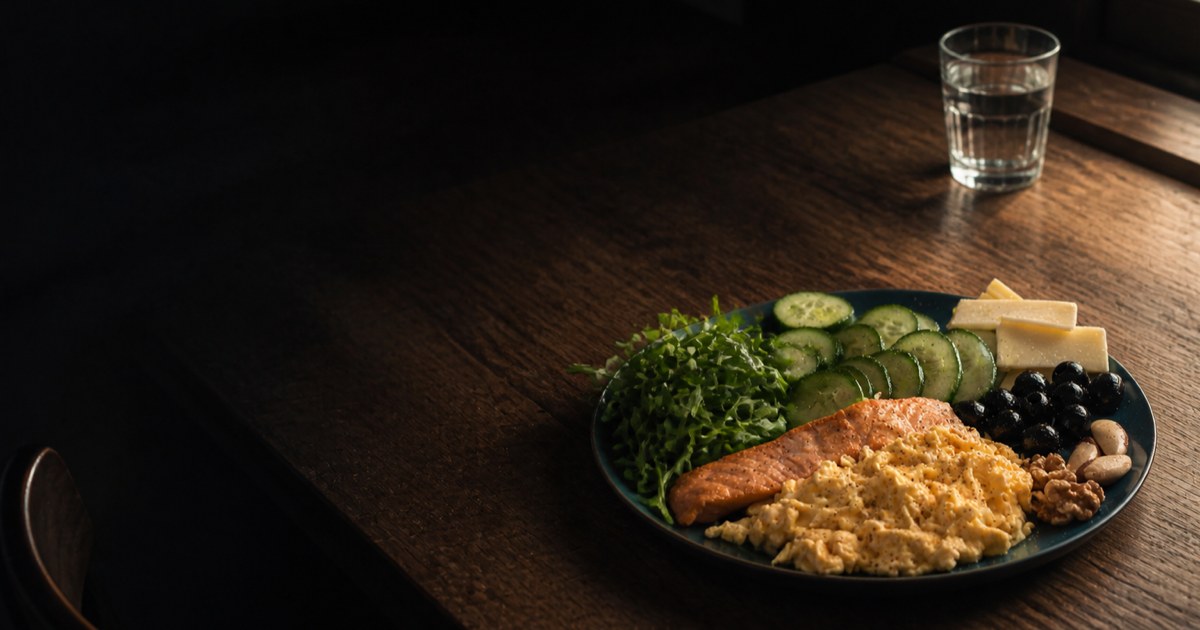
Here is a sentence that sounds like clickbait: I could eat McDonald's for dinner every single night this month and still lose weight.
No trick metabolism. No fat-burner tea. Just arithmetic, and one meal that does all the heavy lifting. A lunch I eat in almost exactly the same form every single day. The same fish. The same eggs. The same olives, the same half cucumber, the same handful of rocket. The same six nuts, counted out like medication. Tomorrow: the same.
People hear "the same lunch every day" and assume discipline. It is the exact opposite. I built this plate so I would never need discipline again.
This post is the whole system. The story of why it exists, the exact template you can copy, the science behind every component on the plate, the honest caveat most health content skips, and the math behind that McDonald's claim. It is long, because it answers the only diet question that actually matters. Not "what works fastest." What still works in year five.
I kept winning the sprint and losing the marathon
On paper, I am excellent at dieting. Seven or more rounds of keto. Multiple strict carnivore blocks. Long water fasts. Fifteen years of eating in an 18:6 window. Every one of those protocols did exactly what it promised: the weight came off, and it came off fast.
Then, every single time, the same second act. The protocol ends, normal life returns, and over the following eleven months the weight comes back. Twice I regained about 14 kilograms. Not in one dramatic collapse. In small, invisible increments. A normal week here. A holiday there. A "back on it Monday" that quietly became a season.
For years I read that as a discipline problem. It is not. It is a design problem.
A restrictive diet is a sprint: intense, impressive, and over quickly. But nobody's health is decided in the sprint. It is decided in the boring eleven months afterwards. The off-season nobody photographs, the stretch every restrictive protocol simply pretends does not exist. I kept winning the part that gets applause and losing the part that counts.
The question that changed everything
So I changed the question. It stopped being "which diet loses fat the fastest." I already knew five answers to that one, and none of them had kept the weight off. The new question: what is a way of eating I could hold for the rest of my life without spending willpower on it?
That question has requirements no sprint ever has to meet. The way of eating has to be:
- Nutrient-dense enough to thrive on. Not just lose weight on. Thrive on.
- Enjoyable enough that quitting never crosses your mind. Tolerable is not enough. Tolerable has an expiry date.
- Cheap enough to run forever. A 400-euro-a-month protocol is a subscription, and subscriptions eventually get cancelled.
- So low-effort it needs zero daily decisions. Decisions are where diets go to die.
- Flexible enough to survive real life. Birthdays, holidays, terraces in summer, family dinners.
No sprint diet meets those five. So I stopped looking for a diet and started engineering a default.
One meal, fully under control
Structure first. I eat two meals a day, lunch and dinner. After fifteen years of 18:6, that is simply normal for me.
Dinner belongs to real life. Family, friends, whatever the evening brings. But lunch I eat alone, at home, every day. Which makes it the one meal in the week that is one hundred percent under my control.
That asymmetry is the entire strategy. Stop trying to control both meals. Control the controllable one completely, and let the other one breathe. So lunch became the anchor: one plate, nutritionally complete, requiring zero decisions, eaten every day. By 2pm I have banked 70 to 80 grams of protein, my omega-3s, my greens, and every nutrient I have ever found a gap in. Whatever happens at dinner, the day is already won.
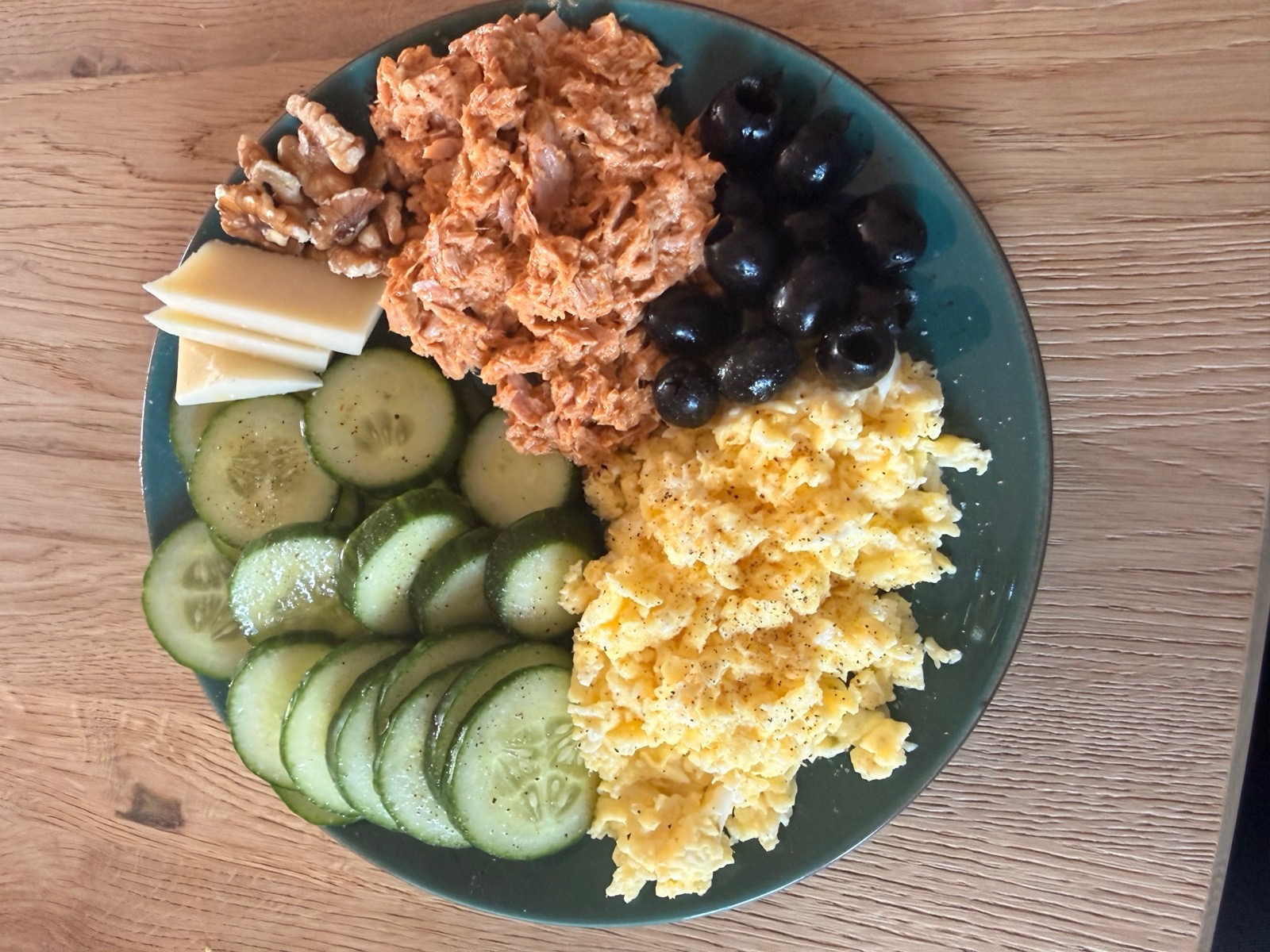
The whole mental model fits in one sentence: you are never more than one meal away from being back on track.
The McDonald's math
Time to cash the opening claim, because it is not a joke. It is arithmetic.
My maintenance, estimated from a four-week Apple Watch average rather than plucked from a formula: about 3,000 calories a day. Roughly 2,535 resting plus 444 active, walking and training included. Watch numbers are estimates, not lab measurements, so treat mine as a personal working figure, not a universal one.
The anchor lunch: about 1,000 calories, 70 to 80 grams of protein.
A large Big Mac menu, burger, large fries, and a cola: roughly 1,300 to 1,450 calories. Add it up and the day lands around 2,300 to 2,450. That is a deficit of 550 to 700 calories, every day, which on paper works out to around half a kilogram of body fat a week. Real bodies are messier than spreadsheets and the rate drifts as weight drops, but the direction is unambiguous: losing weight, on nightly fast food.
To be clear: I do not do this, and I am not recommending it. A dinner like that is nutritionally empty, and the only reason it would even work is that the anchor meal already delivered the day's actual nutrition by early afternoon.
But that is exactly the point. The claim is not "eat McDonald's." The claim is that this system survives the worst realistic input you can throw at it. A system that only works on perfect days dies on the first imperfect one. I know, because every diet I ever failed at needed perfect days. This one does not need my dinner to behave. It only needs my lunch to exist.
Structure without dogma
Now, where the eating style itself comes from.
After my last strict carnivore block (I wrote about that experiment here), I reintroduced foods one at a time and paid close attention. I expected to feel a little worse with every reintroduction. The opposite happened. With a Mediterranean-leaning plate built around an animal core, digestion got better, energy got steadier, and food became genuinely enjoyable again.
Around the same time I looked hard at the loudest carnivore voices, Paul Saladino and the writer behind Carnivore Aurelius. Both built audiences on strict carnivore, and both later reversed to a softer "animal-based" approach, partly after megadosing organ meat gave them real vitamin imbalances. I did not read that as a scandal. I read it as the actual lesson: take the structure, leave the dogma.
The structure I kept: animal foods as the foundation, carbohydrates dosed to activity, no seed oils, no sugary drinks, nothing ultra-processed.
The dogma I left behind: "all vegetables are toxic," "honey is carnivore," and eating liver like it is a multivitamin.
Call the result Mediterranean animal-based. Meat, fish, eggs, and dairy as the base. Olive oil, olives, avocado, nuts, and greens around it. More enjoyable than carnivore, more complete, and, as we will get to, considerably more artery-friendly.
The plate, built one piece at a time
Nothing on this plate was designed top-down or copied from an influencer PDF. Every component was added one at a time, for a specific job. That construction is why I trust it, and why I stick to it. In the order they earned their place:
1. Fish and eggs, the foundation. Oily fish three to four times a week: a full tin of sardines, 100 to 120 grams of herring, or the same in salmon. That is EPA and DHA omega-3 straight from whole food: anti-inflammatory, lowers triglycerides, and about as consistently health-associated as any single habit in the nutrition literature. Small oily fish are also the low-mercury choice. Tuna is the one I cap at about once a week. On the other days, 120 to 150 grams of meat, mostly chicken, with a ribeye about once a week. And always two to three eggs: complete protein, choline, fat-soluble vitamins. The yolk stays. That is where the nutrition lives.
2. Cucumber, the first vegetable back. After carnivore, I reintroduced plants starting with the gentlest one imaginable. Cucumber is mostly water: hydrating, with nearly zero fermentable fiber, so there is nothing to bloat, and no compound anyone has ever seriously warned about. Half a cucumber, sliced, with sea salt and olive oil. The zero-caveat vegetable.
3. Olives and real olive oil, the fat pivot. The most consequential upgrade on the whole plate. Instead of running the fat base on butter and fatty dairy, I shifted it toward monounsaturated fat: olives and extra-virgin olive oil. Oleic acid lowers LDL cholesterol for most people, which directly counters the one real cardiovascular downside of animal-based eating (a full section on that below), and genuine extra-virgin comes loaded with polyphenols. Two practical notes: buy real extra-virgin from a source you trust, because a lot of cheap "olive oil" is quietly cut with seed oils, and count the olive brine toward your salt for the day.
4. Avocado, the adjustable lever. More monounsaturated fat, plus one of the best food sources of potassium, plus fiber, magnesium, and vitamin E. Food is also the only sensible way to get potassium: potassium pills are one of the few genuinely risky supplements (NIH potassium fact sheet). Avocado is not daily. It is a dial. On heavy training days and hungry days it goes on the plate. On lean days it stays in the bowl.
5. Two macadamia nuts and four walnut halves. Yes, exactly. Counted nuts sound neurotic until you hear the reason. Macadamias have the highest monounsaturated fat and the lowest omega-6 of any common nut, perfectly on theme with the olives and avocado. Walnuts are the one nut with a meaningful dose of plant omega-3, plus the best brain-health evidence in the nut literature. Together they cover both bases, and keeping the portion small and fixed keeps the walnuts' omega-6 negligible. Raw or dry-roasted only, never roasted in seed oil. And walnuts live in the fridge, because they go rancid fast.
6. Two Brazil nuts, and that is a hard cap. The most supplement-like food on the plate. Brazil nuts are the densest selenium source on earth, and selenium is what converts thyroid hormone T4 into active T3, the one that runs your metabolism. It is also a building block of glutathione, the body's master antioxidant. But selenium has a narrow safe window, and the selenium content of Brazil nuts varies wildly with where they grew: one to two nuts can already cover or even exceed the full daily requirement (NIH selenium fact sheet). A cheerful daily handful heads toward toxicity. I count them out like pills, two at most, and I let bloodwork confirm the dose instead of assuming my nuts are average.
7. Full-fat Greek yogurt or quark, the gut crew. One or two scoops, plain, always full fat. High-quality protein plus live cultures, which is exactly what a gut wants after years of low-fiber experiments. Low-fat and flavored versions are sugar in a health costume. Living in the Netherlands, full-fat quark is the best value in the dairy aisle. Skyr wins on protein, Greek yogurt on cultures. Pick one, keep it plain. The second scoop is the plate's other dial.
8. Rocket, the gap closer. The final piece, and the smartest. When I audited the finished plate against actual nutrient requirements, one real gap remained: folate, the B-vitamin behind DNA synthesis and red blood cells. One handful of rocket closes it, and throws in vitamin K1, which helps calcium end up in bones instead of artery walls, and dietary nitrates, which convert to nitric oxide: better blood flow, slightly lower blood pressure, better training. All of that for approximately zero calories. Dressed in the same olive oil and salt, it took the plate from "very good" to complete.
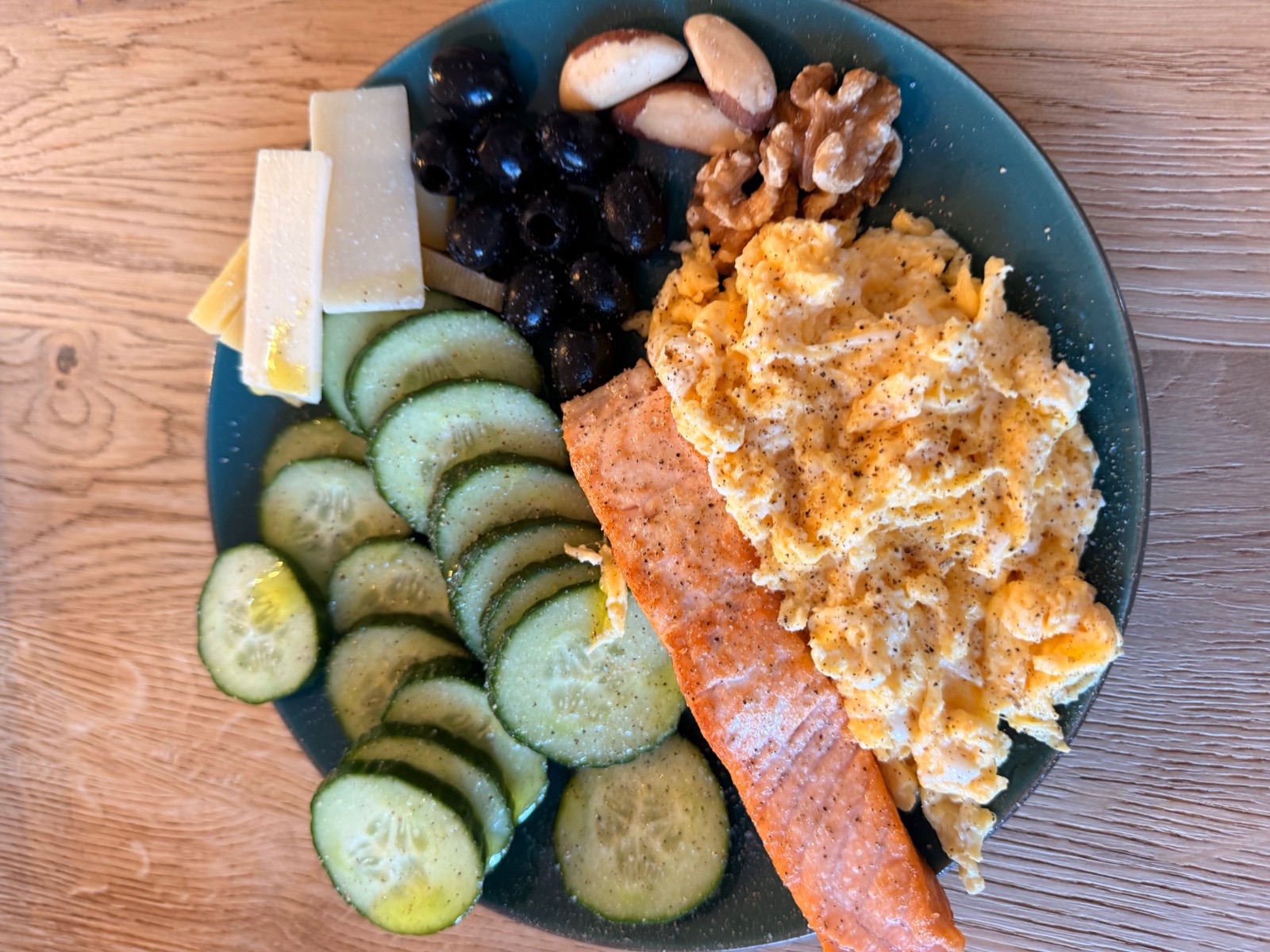
And through all of it, salt. Proper sea salt, used deliberately. Eating lower-carb while training, walking, and using the sauna means I need more sodium than average, and most of the afternoon energy dips people blame on "low carbs" are really low sodium. Black pepper on everything. Sometimes a small handful of berries. Sometimes a little cheese.
The exact template
The plate, precisely, for anyone who wants to copy it:
- Oily fish, about 110 grams (a full tin of sardines, herring, or salmon), 3 to 4 days a week
- On the other days: 120 to 150 grams of meat, mostly chicken, a ribeye about once a week
- 2 to 3 eggs, scrambled or fried
- Half a handful of olives (about 25 grams), plain, in brine
- Half a cucumber, sliced, with sea salt and extra-virgin olive oil
- A handful of rocket, same dressing
- 2 macadamia nuts and 4 walnut halves
- 2 Brazil nuts, hard cap
- 1 to 2 scoops of full-fat Greek yogurt or quark, plain
- Avocado on training and high-hunger days
- Optional: a small handful of berries, a little cheese
- Salt and black pepper throughout
Two dials, nothing else: the avocado and the second scoop of yogurt. Hard training day or genuinely hungry, both go in and lunch runs up to about 1,250 calories. Lean day, both stay out and it runs about 865. The template never changes. Only the dials move.
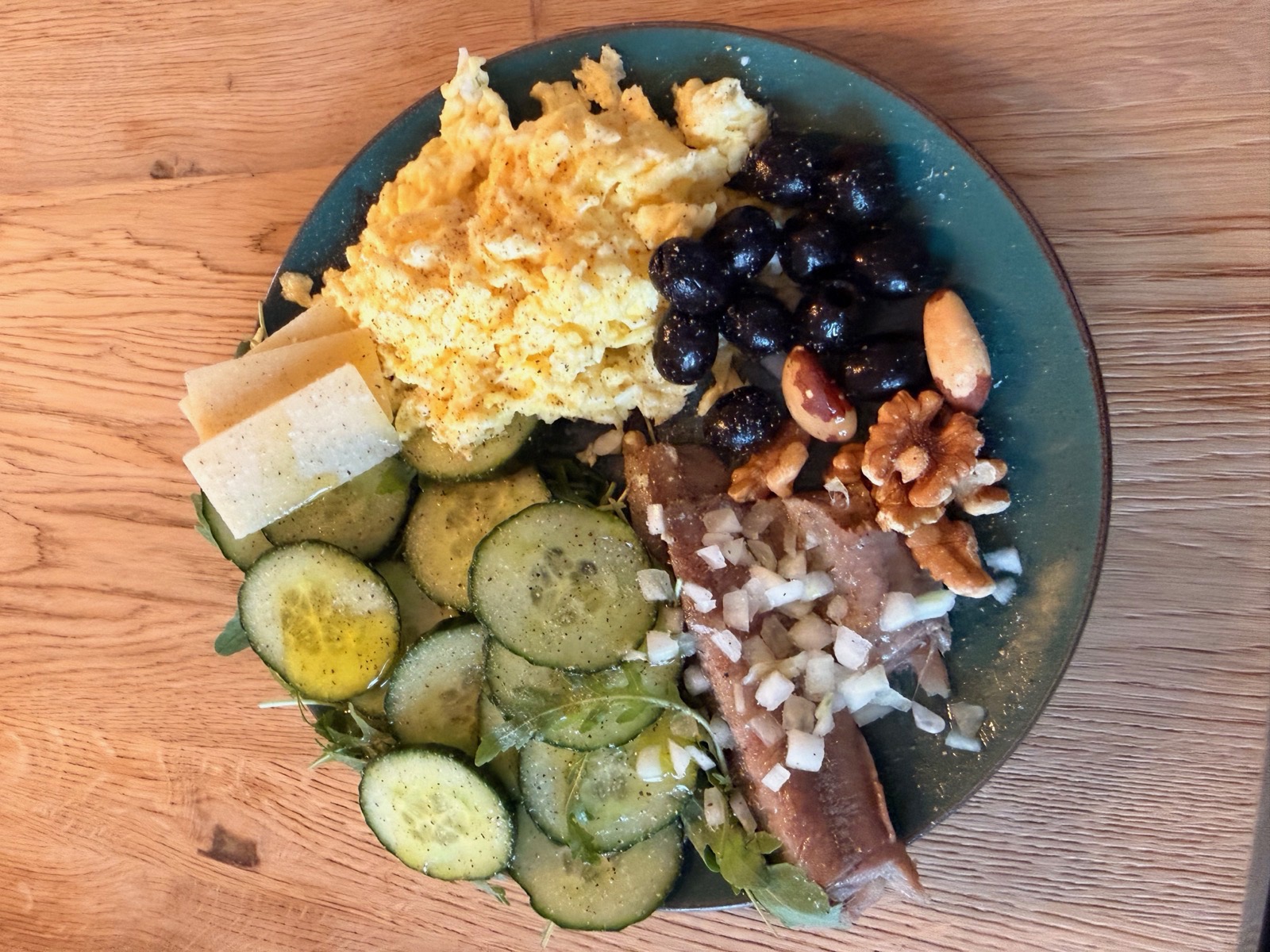
One rule keeps the anchor an anchor: lunch stays carb-light, always. Whatever carbohydrates I have earned through training go to dinner, never to lunch. The anchor stays protein, fat, and greens. That is what makes the rest of the day so hard to ruin.
The numbers underneath
What the plate actually adds up to:
- Lean day (fish, no avocado, one scoop): about 865 calories, 71 grams of protein, 77 grams of fat, 20 grams of net carbs
- Typical day: 1,000 to 1,100 calories, 70 to 80 grams of protein, 20 to 25 grams of net carbs
- Big day (meat, avocado, two scoops): up to about 1,250 calories and 83 grams of protein
Against a measured maintenance of about 3,000 calories, eating 2,000 to 2,500 across both meals lands me in a 500 to 1,000 calorie daily deficit. That is the sustainable fat-loss zone: aggressive enough to see in the mirror, gentle enough to hold for months without white-knuckling.
Protein is the other half of the math. The target is about 150 grams a day, and lunch banks half of it before the afternoon starts. In a calorie deficit, protein decides what you actually lose. Eat too little of it and the scale drops, but a chunk of the loss is muscle: you end up smaller and softer. Eat enough, and train, and essentially every kilogram lost is fat while the muscle stays or grows. That is the difference between "lighter" and "leaner and stronger," and it is decided by protein and training, not by the scale.
One myth worth killing on the way past: "the body can only absorb 30 grams of protein per meal." Mostly false. Muscle protein synthesis per sitting does plateau somewhere around 25 to 40 grams, but absorption does not stop there. A 2023 trial fed people 100 grams of protein in a single meal: all of it was absorbed, and it kept muscle building elevated for longer. Hit the daily total and stop stressing about per-meal limits. Convenient news for anyone eating twice a day.
The gaps, closed on purpose
A principle runs through everything above: targeted beats broad. I did not buy a multivitamin to blanket-cover unknown gaps. I identified the actual gaps and closed each one with a specific food:
- Iodine. The one real hole: sea salt is not iodized and I eat no bread, which are the two default sources. Closed by fish three to four times a week, daily dairy, and eggs. Confirmed with a thyroid panel, not with vibes.
- Folate and vitamin K1. Closed by the daily handful of rocket.
- Selenium. Closed by exactly two Brazil nuts.
- Potassium. Covered by avocado, fish, meat, and yogurt. From food only, never from pills.
Every item on the plate can answer the question "what are you for?" If a food has no answer, it is not on the plate.
The honest part: cholesterol
Here is the section most animal-based content skips, which is exactly why it should not be skipped.
Animal-based eating that is heavy in saturated fat raises LDL cholesterol in many people. And LDL, more precisely the ApoB particle count, is causally linked to arterial plaque. Not correlated. Causally linked (American Heart Association on ApoB). That is about as settled as nutrition science gets, and no amount of steak-influencer hand-waving changes it. Being lean, insulin-sensitive, low-inflammation, and a non-smoker genuinely modifies the risk. It does not erase it.
This is exactly why the fat on this plate leans monounsaturated. Olives, olive oil, avocado, macadamias, and fish, instead of butter on everything. It keeps the structure animal-based while pushing LDL down rather than up. That single shift is the difference between this way of eating and the version that quietly sandpapers your arteries for a decade.
And then: measure instead of arguing. ApoB belongs on the blood panel, not just the standard cholesterol readout. Lp(a) is worth testing once, because it is genetic and it changes the picture. And in my mid-40s I plan a coronary artery calcium scan, to look at the arteries directly instead of inferring.
The internet offers two religions here: "LDL is a myth, eat butter" and "meat is a heart attack." Both are religions. The truth is unglamorous: real risk, real nuance, entirely measurable. So measure.
Why this survives when every diet died
This is the part that separates a default from a diet, and none of it is luck. It was engineered for sustainability, not for optimization.
It is cheap. Tinned fish is a cupboard staple, eggs come by the dozen, chicken gets batch-cooked, olives come in big jars from the Turkish supermarket. The anchor lunch runs 90 to 110 euros a month. A ribeye-heavy version of the same macros, which I priced out, runs 380 to 400. A way of eating is a subscription. This is one I can afford for the rest of my life.
It requires zero decisions. Repetition is not the sacrifice here. It is the feature. No meal planning, no "what do I feel like," no 5pm negotiation with myself in front of an open fridge. Decisions spend willpower, and willpower is exactly the resource every previous diet drained to zero. This runs without it.
Everything is 365-safe. Every component can be eaten daily, indefinitely, with two sensible caps: two Brazil nuts, and reasonable portions of olives and cheese. Nothing needs cycling, rotating, or "refeeding."
Dinner absorbs real life. Birthday cake, pizza with the kids, a long dinner with friends: all of it fits, because the day was already won at lunch. A way of eating with no social cost builds no resentment. And resentment, not hunger, is what eventually snaps every strict diet.
It corrects itself. One weigh-in a week, one guardrail: 100 kilograms. Under the line, full flexibility, no thinking allowed. Over the line, one tighter week: dials out, extras off. The guardrail catches drift at one kilogram instead of fourteen, which turns "I ruined everything" into "lean week, done." Holidays bump the scale with water and glycogen, not fat, and a week back on the template flushes it. No panic, no crash protocol, no shame spiral. This one boring rule is the entire maintenance system, and it is the thing I wish I had built fifteen years ago.
I genuinely like eating it. The most underrated variable in all of nutrition. The best diet is not the optimal one. It is the healthy one you will still be happily eating in thirty years. I look forward to this plate. Every day.
Somewhere along the way, the identity shifted. It stopped being "I am trying to eat well," which is effort, and became "this is how I eat," which is just a fact. A diet is something you are on, which means you can fall off it. A default is something you are. No sprint ever gave me that. A boring plate did.
The rest of the system, briefly
The lunch is the star, but it does not work alone:
- Training: 15 minutes of kettlebell work, about six days a week, hard and easy days alternating. The diet handles the fat. The training decides whether "lighter" becomes "stronger." More on the wider routine here.
- Walks with jobs: an early one for sunlight and circadian rhythm, a post-dinner one to blunt the glucose response, one brisk one for actual cardio.
- Supplements, targeted like the food: creatine, glycine, magnesium, vitamin D3, fish oil. Each one fills a named gap. The overpriced theatre (AG1, reishi, resveratrol) stayed on the shelf.
- Bloodwork: steering by numbers, not by ideology. Especially on ApoB.
Why 40 matters
I will keep this short, because it is the one part of this that is not a system.
My father died at 38. That number has sat quietly in the back of my mind for my entire adult life. It is the real reason the sprints were never going to be enough: you cannot sprint to 80. The whole point of an eating system that runs without willpower, catches its own drift, and survives real life is that it is still running in decades I have not seen yet.
The goal was never a summer body. The goal is to arrive at 40 in the best condition of my adult life, and to keep going. To rewrite an inherited story instead of repeating it. Some mornings, after the weigh-in, the thought is simple: look in the mirror and see a man your father would have been proud to know.
That is what the boring lunch is for.
Same plate tomorrow.
Fab
The anchor meal FAQ
Is eating the same meal every day healthy?
It is exactly as healthy as the meal. Variety is a proxy for nutrient coverage, not a requirement in itself: if you engineer the coverage directly, repetition becomes a strength. This plate was audited against actual requirements, the gaps (folate, iodine, selenium) were closed with specific foods, every component is safe to eat daily, and the result gets confirmed with bloodwork rather than assumed.
Can you really lose weight eating McDonald's every day?
Arithmetically, yes. Against a 3,000-calorie maintenance, a 1,000-calorie anchor lunch plus a large Big Mac menu at roughly 1,300 to 1,450 calories still leaves a deficit of 550 to 700 calories a day. It is a stress test that proves the system's robustness, not a recommendation: the fast-food version only works because the anchor meal has already delivered the day's protein and micronutrients by 2pm.
Why only two Brazil nuts a day?
Selenium. Brazil nuts are the densest selenium source there is, and their selenium content varies widely from nut to nut: one to two can already cover or exceed the full daily requirement. Selenium has a narrow safe window, so a daily handful pushes toward toxicity over time. Treat Brazil nuts like a supplement: count out two at most, stop there, and let bloodwork confirm the dose.
Doesn't animal-based eating raise cholesterol?
Often, yes. Saturated-fat-heavy animal eating raises LDL and ApoB in many people, and ApoB is causally linked to arterial plaque. This template counters it by shifting fat toward monounsaturated sources (olive oil, olives, avocado, macadamias, fish), which lowers LDL for most people, and then by measuring instead of assuming: ApoB on the blood panel, Lp(a) once, and a coronary artery calcium scan in your mid-40s if you want certainty.
How much does this way of eating cost?
The anchor lunch runs about 90 to 110 euros a month: tinned fish, eggs by the dozen, batch-cooked chicken, bulk olives, and quark. A ribeye-heavy protocol delivering similar macros costs 380 to 400. Cost is not a side note. It is one of the main reasons a way of eating either survives or quietly gets cancelled.