Read any expat forum about moving to the Netherlands and you find the same five cities on a loop: Amsterdam, Utrecht, The Hague, Rotterdam, Eindhoven. The complaints repeat too. No housing, dozens of bidders for what exists, and a salary that is gone before the month is.
I live in a province most of those threads could not place on a map. Our house has a garden, and an Amsterdam budget would not buy it as a one-bedroom flat. I am Swiss and moved to the Netherlands in 2016. For ten years I have watched people fight over five crowded cities while Friesland sits two hours north, mostly ignored.
This is the guide I wanted when I was deciding: what Friesland offers, what it costs you, and who should not move here. The personal story of how I ended up here is its own post. This one is the practical version.
Where and what Friesland is
Friesland is the northern province of the Netherlands. The capital is Leeuwarden. A bit over 650,000 people live here, the province has its own official language, Frisian, and there is more water than land planning would normally allow. The North Sea and the Wadden Sea sit on its edge. Inside, it is lakes and canals, which I have written about at length, because sailing is what brought me to this country.
Frisians are direct, even by Dutch standards. They are reserved with newcomers, they hate showing off, and they are loyal once you are in. There is a Frisian word, mienskip, that roughly means community. It is not a slogan on a tourist flyer. It is how villages run.
The housing math
Here are real numbers, because "cheaper" means nothing without them. In 2025 the average home sold for about €319,000 in Leeuwarden and about €631,000 in Amsterdam, according to CBS. That is close to double, and the Amsterdam average buys a smaller home.
In the Randstad you compete with dozens of bidders for a small apartment. Here, a family house with a garden in a village costs about what a modest flat costs in the west. We bought a house in Goutum, just south of Leeuwarden, at the start of 2026. It has a garden and room for two kids and a dog, and the mortgage does not decide every other part of our life.
That is what cheap housing buys you. One income can carry a family here if it has to. A business can survive a slow quarter. One interest-rate surprise does not put you in a panic. I have written before about how much of the "how much do I need" question is a housing question in disguise.
Do not expect it to stay cheap, though. Prices in Friesland rose 9.2 percent in 2025, faster than in Noord-Holland, CBS reported. The gap is big, but other people have found it too.
The work question
This is the filter that decides whether Friesland works for you at all.
If your income does not depend on where you live, Friesland is close to a cheat code. A remote job, freelance clients, your own business, customers in Germany or Switzerland: you earn at big-city rates and pay Frisian costs. That is my setup. I run a web studio and several projects from here, and so do most of the happy internationals I know.
If you need a local corporate career ladder, be careful. The local economy is real but narrow: farming and food, water technology, tourism, healthcare, education, and the public bodies in Leeuwarden. There are good employers, and fewer people apply for each job than in the west. But there are far fewer jobs, and senior international roles are rare. Some people commute to Zwolle or Groningen a few days a week and work from home the rest.
Friesland suits people who bring their income with them or build it here. It is hard on people who expect Amsterdam's job market with cows.
Language: three of them, one rule
The Netherlands runs on Dutch. Friesland also runs on Frisian. Most people under seventy speak good English.
The rule: learn Dutch anyway. English lets you get by for years without ever really arriving, and the language is the difference between living in a place and living next to it. You do not need Frisian, and nobody expects it from a newcomer. Learn a few words and watch faces change. Our kids will grow up switching between all three without thinking about it.
What you get
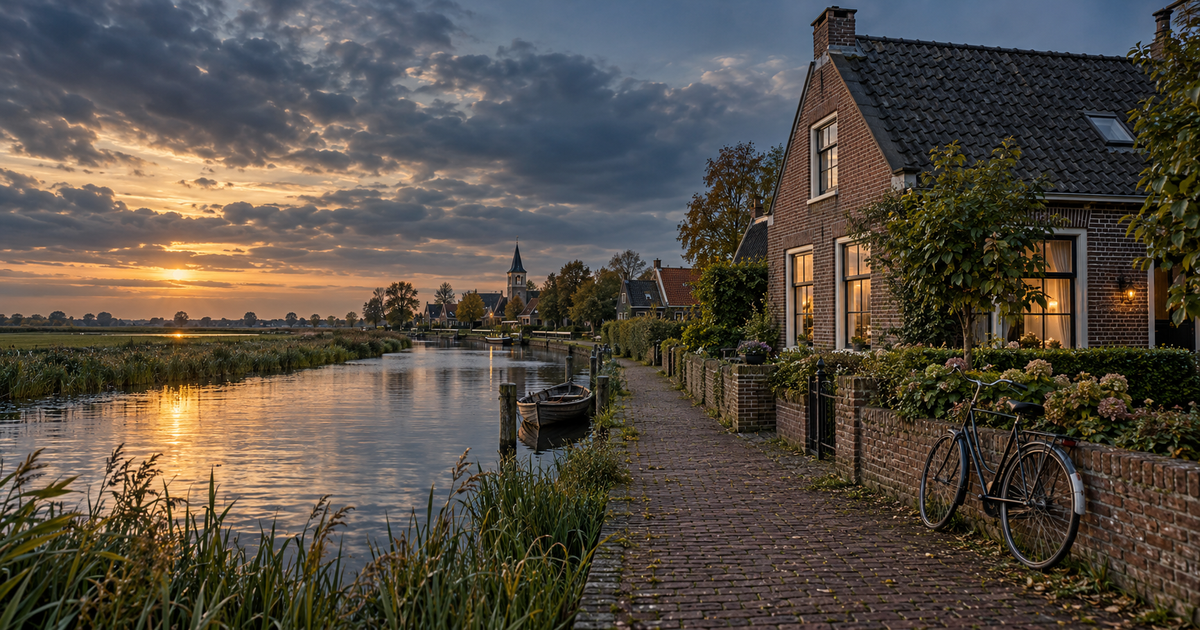
Space, sky, water. The land is so flat that the sky does most of the scenery. Every village has a harbor, and open water is minutes away from most homes. If boats mean anything to you, I do not know a better place in Europe to live at this price.
Time. The commute is short. The school run is a walk or a bike ride. Visitors from big cities call the pace slow. It is a calendar with room in it.
Safety and childhood. Kids here cycle to school on their own from a young age. That does more for daily life than any number of museums.
Community that means it. It takes a year or two to be let in. After that, neighbors turn up without being asked, with tools and opinions.
A real cultural identity. Friesland is not a suburb of the Randstad. It has its own language, its own sports (look up fierljeppen, then skûtsjesilen), its own stubborn history, and no interest in what Amsterdam thinks. As a Swiss, I knew this mindset straight away from the mountain villages. Friesland is what you get if you flatten the Alps and add water.
What you give up
I promised the other column too.
City life on demand. Leeuwarden is a pleasant small city with more culture than outsiders expect. It is not a metropolis and does not want to be. For real big-city energy you go to Amsterdam or Hamburg, and both are a proper trip. Schiphol is about two hours by car or train.
An expat bubble. There is no large expat scene, the choice of international schools is far smaller than in the Randstad, and there is no ready-made group of people in your exact situation. You have to integrate. Some people find that freeing. Some find it lonely. Know which one you are.
Wind. It is not that cold here. It is windy, all the time, and the wind comes in flat from the side. You buy a windproof jacket, you grow calf muscles, and one day you stop talking about it. That is how you know you have settled in. The big skies make up for it.
Career options. I covered this above, but it belongs in this column too. If you might need a new local employer every three years, the west of the country has more of them.
Who should not move here
- People who get their energy from city crowds, scenes, and last-minute plans. You will be bored, and Friesland will not apologize.
- People who need many local corporate jobs in one narrow field.
- People who want to live in English only. That works in Amsterdam. In a Frisian village it does not, and it is rude to the place.
- People running away from a problem. A quiet province does not fix it. It gives it more room. Move toward a life, not away from one. I have a framework for that decision if you are standing at it.
The practical checklist
The full admin detail is in the story post. The short version:
- Register at the gemeente (the town hall) and get your BSN first. Nothing works without it.
- Arrange Dutch health insurance within four months. It is mandatory.
- Expect opening a bank account to take more paperwork than the country's reputation suggests.
- Start Dutch lessons in month one, not year two.
None of it is hard. None of it is fun either.
Ten years in
I came to the Netherlands for sailing, stayed for Nikki, and built a family, a house, and several businesses here. Every few months I visit somewhere bigger, more famous, and more expensive. Every time I drive home over the Afsluitdijk I end up in the same place. I want a family, work I control, water out the window, and money that is not always tight. For that life, this unfashionable province is the best trade in Europe I know of.
The Randstad is a fine place to visit. Friesland is a place to live. Just do not tell too many people. Those 2025 house prices say a few already know.
Fab
Moving to Friesland FAQ
Is Friesland a good place to live?
For families, remote workers, and anyone who wants space, water, safety, and community more than city life, it is one of the best-value places to live in northwestern Europe. If you need big-city energy or a large local job market for corporate careers, it is the wrong choice.
Is Friesland cheaper than Amsterdam?
Yes, mainly because of housing. In 2025 the average home sold for about €319,000 in Leeuwarden and about €631,000 in Amsterdam, according to CBS. Groceries and services cost about the same as in the rest of the Netherlands. Prices in Friesland are rising fast, though: up 9.2 percent in 2025.
Do I need to speak Frisian to live in Friesland?
No. Dutch is what you need, and English gets you through the first year. Frisian is the province's second official language and locals like hearing a few words, but nobody expects a newcomer to learn it.
Can I find work in Friesland as an expat?
The safest setup is income that does not depend on where you live: a remote job, freelance clients, or your own business. The local economy (farming and food, water technology, tourism, healthcare, and Leeuwarden's public bodies) is real but smaller than the Randstad's, especially for senior international roles.
What are the downsides of living in Friesland?
Constant wind, a small expat scene, fewer local career options, and distance from big-city culture. Schiphol is about two hours away. You have to integrate through the Dutch language. If you come only for cheaper housing and do not want village life, it will not suit you.