
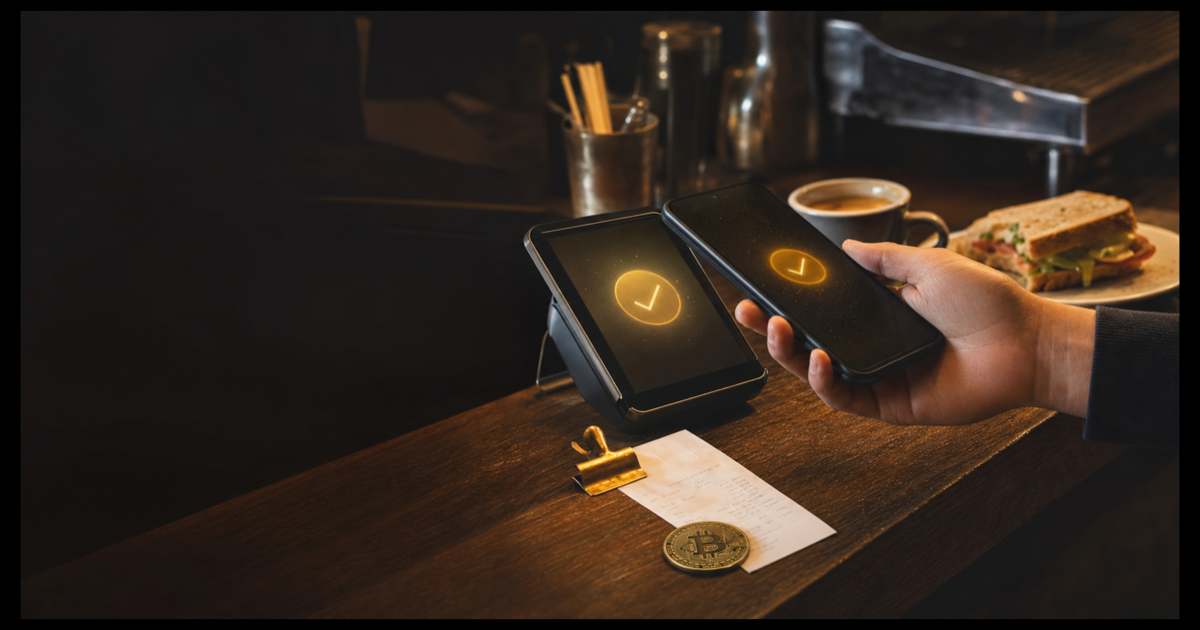
A few weeks ago I bought a coffee and a broodje at a café about fifteen minutes from my house and paid with Bitcoin. The whole transaction took maybe eleven seconds. The owner glanced at her tablet, nodded, and went back to the espresso machine.
That is the entire story. And that is exactly why it matters.
Because for most of the last decade, paying with Bitcoin in the real world was a performance. You announced it. You explained it. Someone fetched a manager. There was a QR code that would not scan, a fee that made no sense, and a long wait while everyone pretended this was normal. I have been that guy. It was not a good look for anyone involved.
Something changed. Not everywhere, and not all at once, but enough that I want to write down what actually works now, what still breaks, and what I have learned from the far less glamorous side of this: convincing real business owners in Friesland to accept it.
The Thing Bitcoin People Do Not Like Talking About
There is an uncomfortable split in Bitcoin circles, and it is worth naming honestly.
One camp says Bitcoin is money, and money is for spending. If nobody ever transacts, you have a collectible, not a currency.
The other camp says spending Bitcoin is the single dumbest financial decision available to you. Why hand over an asset you believe will be worth multiples more later in exchange for a sandwich? There is a famous pizza that cost ten thousand coins and now functions mainly as a cautionary tale.
Both camps are right, which is annoying.
I hold most of my Bitcoin and have no intention of spending it. I have written about why it is roughly a quarter of my portfolio and why I have not sold through a single crash. But I also keep a small spending balance, deliberately, and I use it. Not because it is financially optimal. Because a payment network nobody can actually use is a network that quietly dies, and I would rather help keep it alive than write posts about how one day it might matter.
Think of it the way you think about the cash in your wallet versus the money in your pension. Different jobs. Nobody is confused about this in any other context.
What Actually Works Now
Here is the practical version, without the ideology.
Lightning is the answer for anything under a few hundred euros. This is the part that genuinely changed. Payments settle in about a second and cost a fraction of a cent. The experience is now close to Tikkie or a contactless tap: scan, confirm, done. If your mental model of Bitcoin payments is still "ten minutes and a three-euro fee," you are working from outdated information. Most people's objection to Bitcoin as money was a Lightning-shaped hole, and it has largely been filled.
On-chain is for larger amounts, and no longer feels absurd. Buying something meaningful on-chain is fine: a boat, a bike, a chunk of freelance work. You wait for a confirmation, you pay a real but reasonable fee, and it settles with a finality bank transfers cannot match. It is the wire transfer of this world. You would not use a wire to buy a coffee either.
A modern wallet does most of the thinking for you. The good ones handle the routing, the channel management, and the on-chain-versus-Lightning decision without asking you to understand any of it. My rule for anyone starting: use a wallet where you control the keys, keep the balance small enough that losing the phone would be irritating rather than catastrophic, and write the recovery words on paper. If that sounds like a lot, my beginner's guide to Bitcoin walks through the whole thing properly.
Set your display currency to euros. Small thing, enormous effect. Watching a balance in sats while trying to buy lunch makes you feel like a day trader. Watching it in euros makes it feel like money.
What Still Breaks
I said I would be honest, so.
Refunds are genuinely bad. There is no chargeback, no calling the bank, no reversing anything. If you overpay or settle the wrong invoice, you are relying entirely on the other person's goodwill. For a café transaction, fine. For anything larger with a stranger, it is a real risk the ecosystem still waves away too easily.
Volatility is not solved. It is just moved. The merchant either takes the price risk or converts instantly and pays a conversion fee. Neither is free. Anyone telling you volatility is a non-issue for merchants has never run a business on a four percent margin.
Bookkeeping is the actual bottleneck. In the Netherlands, as in most places, spending Bitcoin means disposing of an asset, and a business accepting it has to book the euro value at the moment it lands. It is not complicated once your accountant has seen it twice. It is very complicated the first time, and this, not the technology, is the single most common reason a business owner says no. I am not your accountant and this is not tax advice. Talk to someone who signs their name under it.
Adoption is patchy. You cannot live a full Bitcoin lifestyle here. Not yet. You can spend it at a specific and slowly growing list of places, which is a completely different claim, and anyone promising the first one is selling something.
What I Learned Trying to Sign Up Merchants
This is where I stopped being a Bitcoin enthusiast and started being useful.
Through Bitcoin Friesland, I have had a lot of conversations with local business owners about accepting Bitcoin. I went in braced for technical arguments. I have had almost none.
Nobody has ever asked me about block size or decentralisation. Not once. Here is what they actually ask, in order:
1. How long does it take at the counter?
2. Do I get euros in my bank account, or am I stuck holding the coin?
3. What does it cost me compared to my card terminal?
4. What do I tell my accountant?
5. Will anybody actually use it?
Five questions, all boring, all completely reasonable. The businesses that say yes are almost never ideological. They like the two to three percent they stop paying the card networks, they like getting paid instantly instead of in three working days, and they quietly enjoy being the shop in the village that does something the chains do not.
The fifth question is the honest problem. A merchant who accepts Bitcoin and sees zero Bitcoin payments in six months will switch it off, and they will be right to. Which loops straight back to the earlier point: spenders and merchants only exist because of each other. That is why I keep a spending balance even though holding would look smarter on a spreadsheet.
Friesland turns out to be unusually good ground for this. It is a province with a long, stubborn independent streak and a lot of small owner-operated businesses where the person you are talking to can simply decide, on the spot, without a committee. I did not expect that when I moved here from Switzerland, but it makes sense in hindsight.
The Beer Test
I will admit some bias here, because I co-founded a craft beer brand you can buy with Bitcoin. Beer of Satoshi started as a slightly absurd idea and turned into the most effective piece of Bitcoin education I have been involved in.
Explaining sound money to someone at a bar does not work. I have tried, at length, to the visible regret of everyone present. Handing them a beer and having them pay for the next round by scanning a code works remarkably well. They do not walk away understanding monetary policy. They walk away having used it, which is a much stickier kind of understanding.
Every serious payment technology went through this. Nobody adopted contactless cards because of an argument about NFC. They adopted it because someone showed them once and it was faster.
What I Actually Do
To make this concrete, here is my whole system. It takes roughly zero maintenance.
- The large majority of my Bitcoin sits in cold storage. I do not touch it, I do not trade it, I have not sold in any crash since 2017. That is the do-nothing part of the portfolio, and doing nothing is the entire strategy.
- A small Lightning balance lives on my phone. Deliberately small: enough for a few weeks of coffees, meals, and the occasional freelancer invoice.
- I top it up occasionally, in a boring and unemotional way, without agonising over the price.
- I spend it wherever it is accepted, even when a card would be marginally easier, because the network only works if people use it.
- I keep a note of what I spent and when, because my accountant asked me to, and because arguing with a tax office from memory is a bad plan.
That is it. It is not clever. Clever is how people lose money.
The Question Underneath
Almost every conversation I have about Bitcoin eventually turns into a different conversation.
Someone asks whether they should buy some, and forty minutes later we are talking about their mortgage, their pension, whether their business actually makes money, and what they want their life to look like in ten years. The Bitcoin question was never really the question. It was the socially acceptable way to open a conversation about money that most people have nobody to have.
That pattern is exactly why I started Unfiltered Advice: an hour or ninety minutes, one on one, where we skip the small talk and look at the whole picture instead of one asset in isolation. Not coaching, not therapy, not a licensed advisor telling you what to buy. Just the direct, connect-the-dots conversation I had been having with friends for free for years.
Because here is the thing about buying a coffee with Bitcoin. It is a small, almost trivial act. But it is the difference between believing in something and using it, and that gap, in money as in most things, is where all the interesting stuff happens.
Fab